


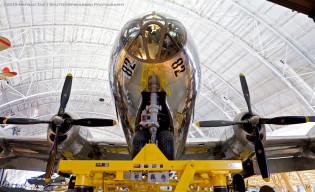
 @ Chantilly, VA
August 2018
One of the centerpieces of the collection at the Steven F. Udvar-Hazy Center is the Enola Gay. The Boeing B-29 Superfortress is a four-engine propeller-driven heavy bomber flown operationally during World War II and the Korean War. It was one of the largest aircraft operational during World War II and featured state-of-the-art technology. Innovations introduced included a pressurized cabin, dual-wheeled, tricycle landing gear, and an analog computer-controlled fire-control system directing four remote machine gun turrets. On August 6, 1945, this Martin-built B-29-45-MO dropped the first atomic weapon used in combat on Hiroshima, Japan. In 1946 this aircraft was transferred to the Smithsonian Institution, fifteen years later she was disassembled and transported to the Smithsonian’s storage facility. The subject of a ten-year restoration, the Enola Gay has been on display here since 2003. First flown in 1994, they remained in service until 1960. Of the 3,970 B-29s built, 26 complete B-29’s are currently on display in the United States. Fuji X-E2s w/18-55mm.







