


I am a self-employed gardener and that suits me just fine. But it does mean that I don’t get certain benefits. No work pension. No sick pay. No holiday pay. No pay if I just feel like lying in bed, eating lemon bon-bons. And no work-chums. But hey, you weigh things up and you make your choice, don’t you? And on the plus side I get to work in a garden that is beautiful and peaceful and ever-changing; and always interesting. And one benefit which didn’t occur to me when I took the job, was the amount of wildlife I would get to see. Some of them like moles and deer …
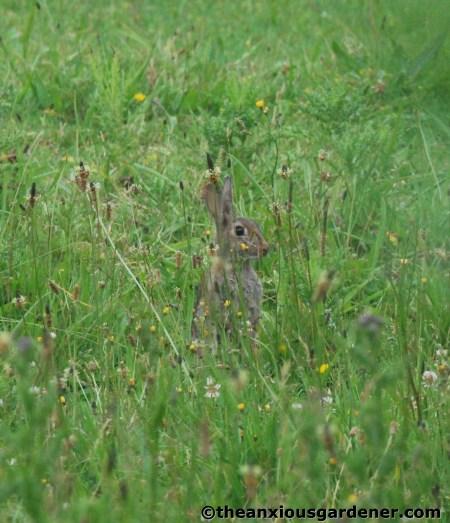
… and rabbits …
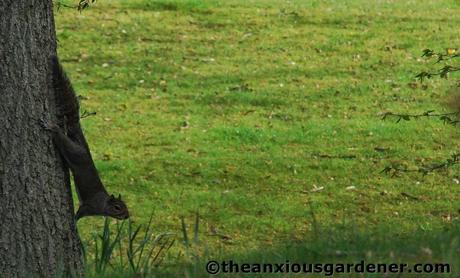
… and gray squirrels, I could frankly do without. But birds I generally encourage with open arms. Some are transient visitors like these …
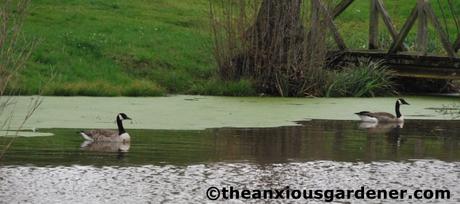
… Canada Geese. As soon as they catch a glimpse of my mug they’re off; shame, they look rather nice on the east pond – though I guess it’s better not to have them in residence, traipsing into the borders.
I have problems with photographing some of the birds. “We’re gonna need a bigger lens” for a start. But I haven’t even seen the tawny owl (let alone photograph it) and while I do occasionally see kingfishers, I can’t offer you photographic evidence. I love the green sandpiper; a regular visitor but who flies off at the first whiff of the gardener. I’ve been close enough to virtually jump on a buzzard and a sparrowhawk – just never when I’ve had my camera.
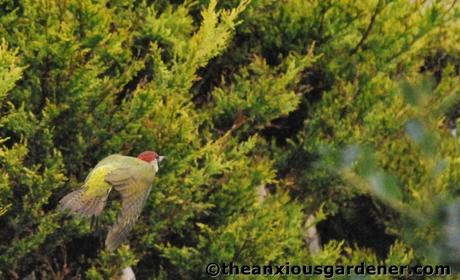
Green woodpeckers avoid me (which hurts) but, thankfully, there are plenty of garden birds that will let me get pretty up close and personal.
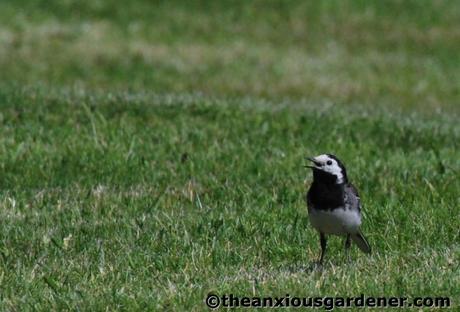
Pied wagtails, for example, always appear as soon as I start mowing. I guess the shorter grass disturbs and reveals their insect prey. And a pair of …
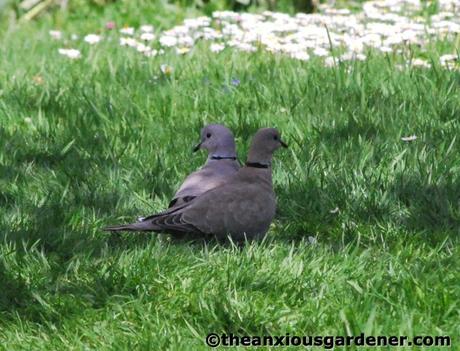
… collared doves, seem so into one another that they barely notice me. Did you know that collared doves only arrived in the UK during the 50’s? For me, they seem so quintessentially a part of an English summer, that I find that fact hard to accept.
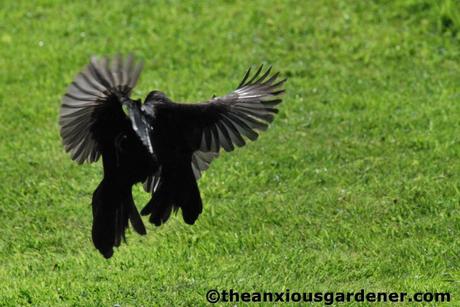
Here two male blackbirds are fighting. It was over pretty quickly with no apparent physical damage – just a few ruffled feathers and tarnished pride.
But obviously the best way to encourage birds to your garden is to feed them. We have four feeders at the Priory and the range of species we attract is wide. I had never seen a …
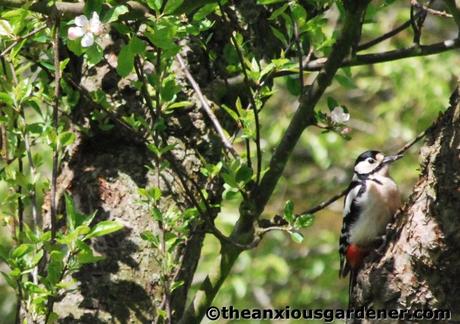
… Great spotted woodpecker before they started visiting one of the peanut feeders.
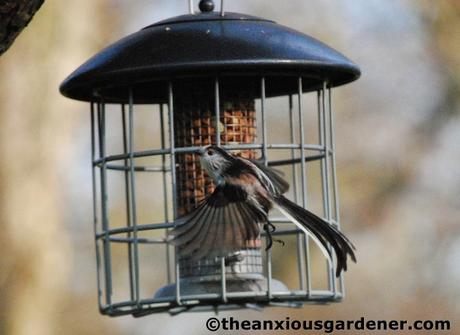
And though they don’t hang around, long-tailed tits are regular visitors. Awwww.
Recently those rather nice people at Nature’s Feast very kindly sent me a bird-feeding kit.
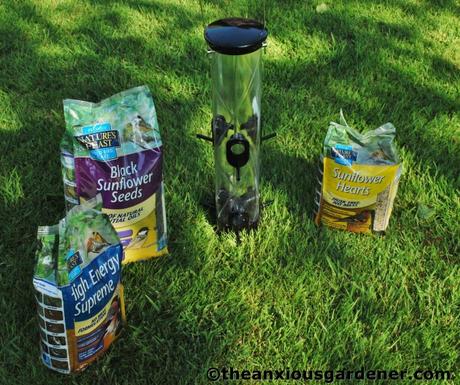
It consists of a ‘Tornado Twist Feeder’ that holds three different types of food and so, in theory, should attract a wider range of species than a conventional feeder. Did it work?
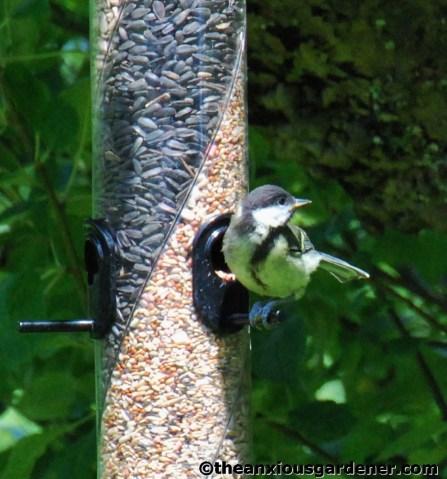
In no time at all, a young great tit was checking it out and …
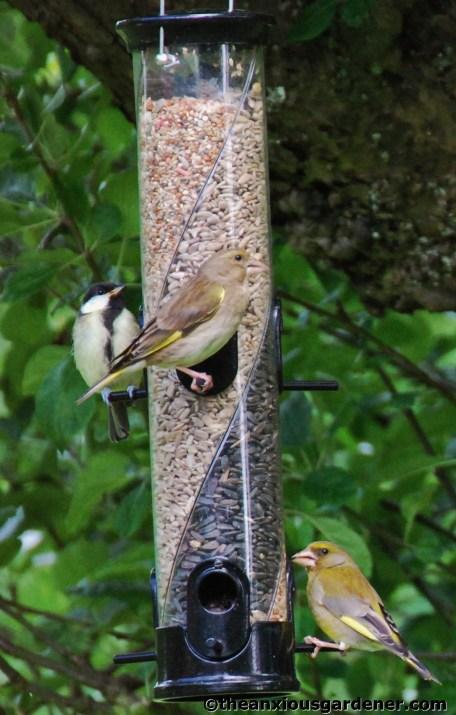
… soon there were a pair of greenfinches as well…
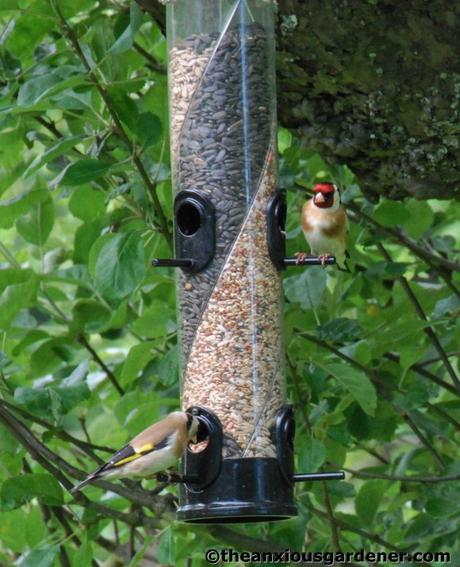
… and goldfinches too.
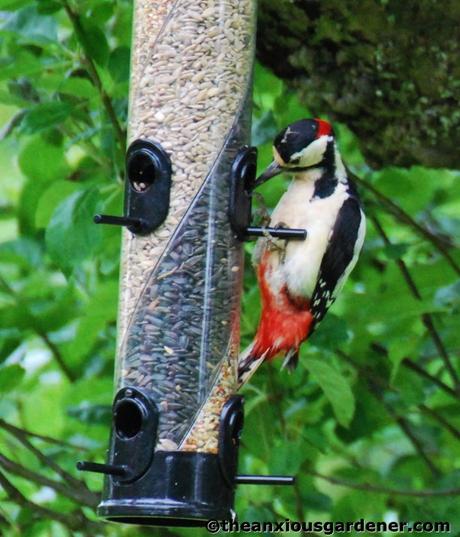
My neighbourhood woodpecker took a break from peanuts to try black sunflower seeds …
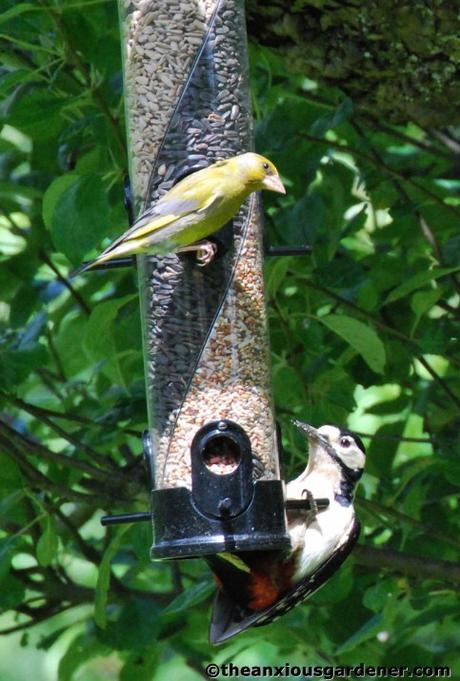
… though he seemed a little put out at having to share the feeder.
An impressive feeder then. My only criticism of it, is that its internal, non-removable plastic spiral makes it difficult to clean. To be fair though, I’ve never had a feeder that was easy to dismantle and wash – but they should be. (Manufacturers please note). I wrote a post a few months ago about some deformed birds that I’d seen in the Priory gardens (see ‘Beaky and the Nest Boxes’). One of the resultant comments had me writing to the RSPB to seek more information about beak malformations and avian pox. The full text of their reply is below but basically – make sure that you regularly clean your bird feeders. It is very important.
As I’ve said, the design of feeders doesn’t make this particularly easy; I find the easiest way is to dunk the feeder into a bucket of bleach solution, thoroughly rinse off (removing any food), air dry and re-use. I do this every time I re-fill them – which is usually daily. Time-consuming but necessary. If you don’t, I’m afraid that you risk spreading avian pox, and other diseases, amongst the birds using your feeders. Something none of us want.
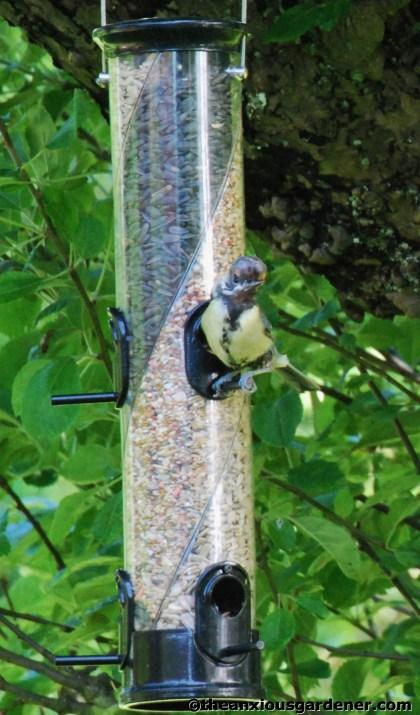
Not necessarily avian pox but a badly diseased great tit nonetheless
If you find diseased birds in your garden, the RSPB have asked that you do contact them (UK readers only). They give the address below.
But I think I ought to finish this post on a lighter note than pox and pestilence.
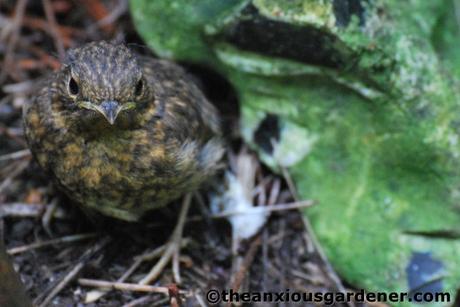
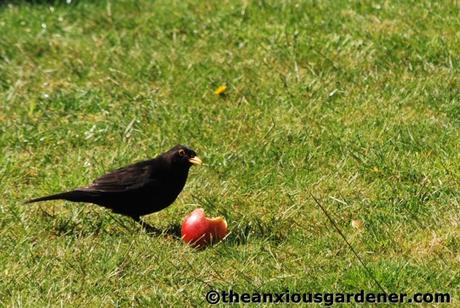
So here’s a juvenile blackbird that I almost trod under boot. By sheer luck (and my jungle-cat, lightening reflexes), I didn’t. So there you go – a happy ending. (But remember to clean your bird feeders).
Here is the full text of the RSPB’s email:
Blue tits are known to be affected by avian pox, and it is possible that the birds referred to by your correspondent did have the pox virus. Having said that, without a more detailed description on the colour, size and texture of the lumps I would not want to be too definite about it. A smooth gray or brown lump up to a certain size tend to turn out to be ticks, but if the lump is pink or red, especially if it is more irregular in shape, it is most likely to be a pox lesion. Avian pox is transmitted first and foremost by biting insects, with secondary transmission by direct and indirect contact from an affected bird. The only thing people can do if poxy birds turn up in the garden is to step up the hygiene regime, especially by daily wipe of the feeder perches and seed ports with a disinfectant. There is no necessity to stop feeding. As you know, the RSPB is involved with monitoring incidents of disease in garden birds, currently with particular emphasis on trichomonosis and avian pox. It would be great if you could direct people who say that they have sick birds in the garden to our website http://www.rspb.org.uk/advice/helpingbirds/health/sickbirds/index.aspx They can report the birds by filling in and emailing or posting to us the disease reporting form downloadable from the pages on tricho and pox.
The beaky blue tit in your pictures seems to have a normal lower mandible and a long upper mandible. Abnormal beak growth does happen from time to time, and can result in a whole range of beak shapes. In most cases, this is caused by damage to the beak or its growth point; often mechanical damage through injury, but sometimes also through actions of feather mites that burrow into the growth point of the beak. Normally, if the mandibles end up different lengths, the fact that the beak tips don’t meet, will result in uneven growth of the mandibles resulting in a beak bent in one direction or another. I find your blue tit quite unusual in that the elongated top mandible has grown with only minor curvature without the lower mandible balancing it out. The bird appears in good conditions, so it has clearly adapted to its disfigurement well, although I would have thought that it must have some difficulty picking up and handling food because of the scale of discrepancy in the mandible lengths. The BTO have been running a survey of beak abnormalities. Perhaps you would be interested to check out their website and report your bird to the survey.






