


I’m back home safe and sound from my winter walking adventure in Yorkshire and Cumbria. It’ll take a few days more to sort through all the photos and come up with some wordsandwordsandwords.
In the meantime …..
A few weeks ago, I posted some photos of blue tits using the bird feeders at the Priory. After first uploading those photos onto my PC, I noticed some rather unsettling details about some of the birds.
For example, this blue tit has some kind of feather baldness (?) around its right eye. Its missing some of its facial colouration and its customary black stripe – not that it seems particularly bothered.
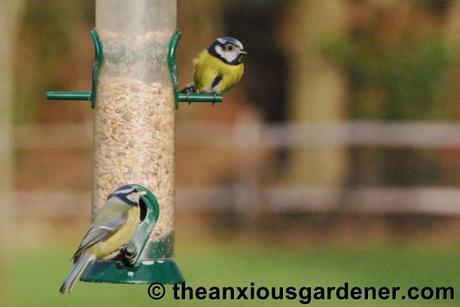
I also had some photos of a great tit which frankly, are too gruesome to publish. The poor thing had a nasty cancerous growth eating up one side of its head. Horribly disfigured, it was still feeding happily enough (hence my photos of it on the feeder) but I do wonder how long it can survive such an affliction. As if life wasn’t difficult enough for these little birds.
And then there was this chap. When I first saw it on the feeder, from a distance, I thought, “How odd. It’s using a stick to feed.”
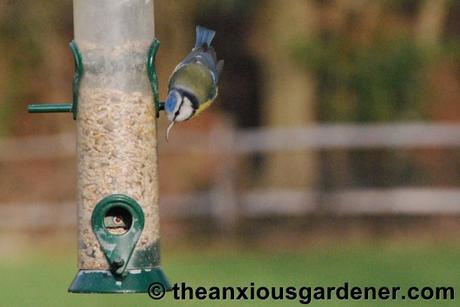
But when I studied it later on-screen, I realised that the ‘stick’ was actually its beak.
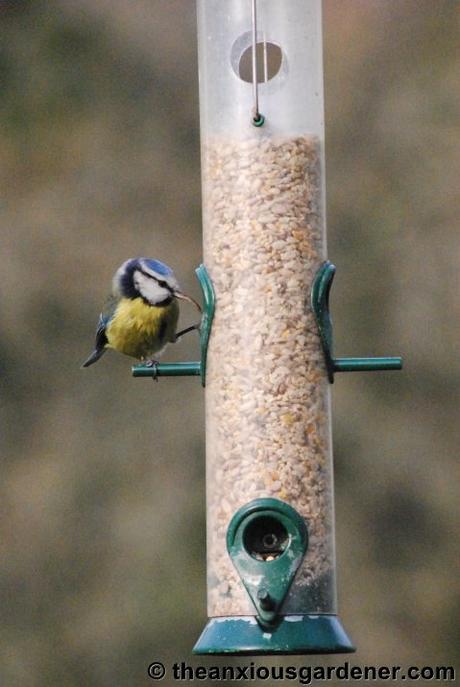
It still manages to feed –
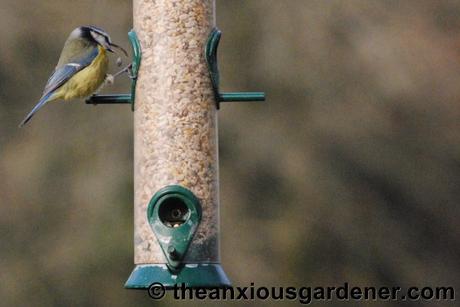
… mostly. Otherwise, it seems healthy enough – though again I wonder how long it might survive with an accoutrement that can’t really be of benefit. Hang on. Unless, unless it’s a new species? Previously unknown to science, living quietly here in the Sussex Weald. In which case I hereby name it Marsden’s Tit! I shall be world-famous!
Thankfully, most garden birds seem to be in …
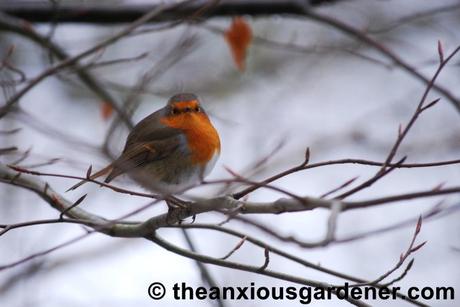
Robin
…robust …
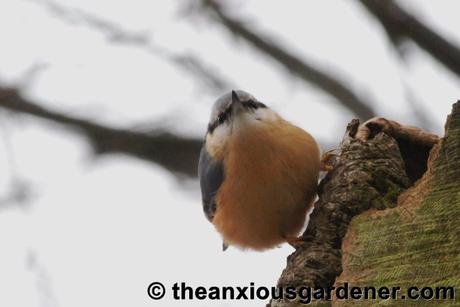
Nuthatch
… and hearty …
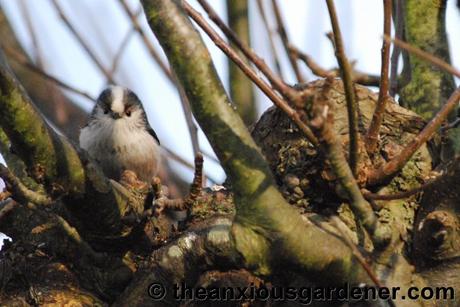
Long-tailed Tit
… good health.
I spent my first morning back at the Priory cleaning out the nest boxes. I’ve made eleven of these: an owl box, a robin/fly-catcher box and nine tit boxes.
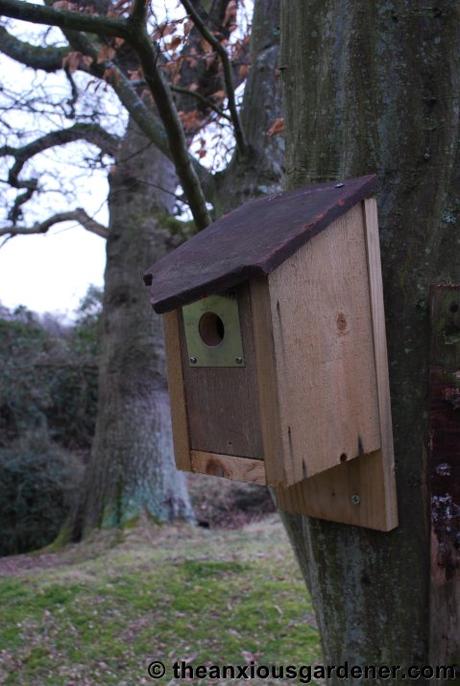
This box, up by the greenhouse, was used last year
After an unfortunate incident with a gray squirrel (beastly creatures) two years ago, I fitted all the boxes with metal plates to stop dratted twitchy-nosed rodents from enlarging the hole and feeding on eggs and baby birds. They seem to work a treat.
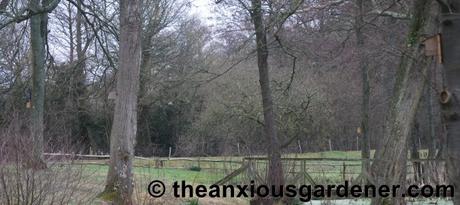
Six boxes in this photo. Can you find them all?*
Of the nine tit boxes, six were used last year and the other three had evidence of roosting (feathers and droppings). I moved one of the unused ones as it was badly sited and I’m hoping for a better take up rate this year. The robin box still hasn’t been used. Humpf.
I also clambered up a very tall ladder (terribly brave, me) to examine the owl box that mandarin ducks used last year. Inside on a bed of soft moss …
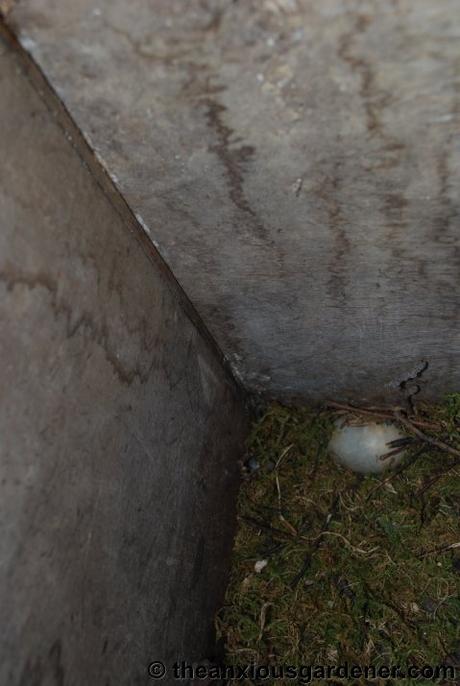
… was a lone addled egg (which I absolutely did NOT throw into Margaret’s field). I never did see any baby mandarins so who knows what happened to them or the other eggs. Underneath the moss was about five inches of foul-smelling gunk and twigs – an old pigeon nest. I obviously forgot to clean out it out last year. The whole bucket of stinky waste that I removed had probably made the box too shallow for tawny owls anyhow (it should be about 32 inches deep). There are so many owl pellets in the garden at the moment (more than I’ve ever seen before) and an abundance of vole holes and tunnels. So come on Tawnies – you’re at the Priory, there’s tons of food. Now just use the flipping box would you?
* Sorry, I meant five.






