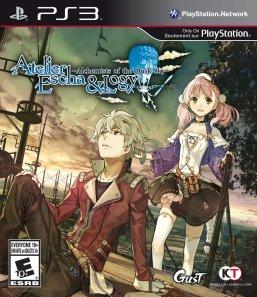
 Title: Atelier Escha & Logy ~Alchemists of Dusk Sky~
Genre: Alchemy RPG
Publisher: Tecmo Koei
Developer: GUST
System: PS3
Release Date: 11 March 2014 (NA), 27 June 2013 (JP)
 Title: Atelier Escha & Logy ~Alchemists of Dusk Sky~
This is the first Atelier title that Gust has released since being bought by Tecmo Koei, and is the continuation to Atelier Ayesha. It takes on a rather experimental approach by introducing two protagonists and a revamped battle system that borrows from Mana Khemia.
First off, despite whatever promotional images and claims say, you get to choose between two protagonists but you do not experience two different storylines. The two titular protagonists, Escha and Logy, are new members of Colseit’s R&D Department, to be working as alchemists in the atelier. The two are practically joined at the hip, and whatever cutscene differences that picking the other brings amounts to no more than 10% of the story. Think less like Mana Khemia 2, and more like Tales of Xillia, in that the two protagonists are almost always together and experience the same plot.
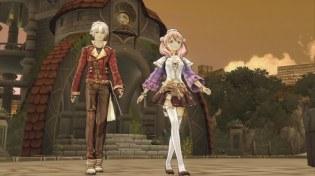
Escha & Logy is the sequel to Atelier Ayesha, taking place in the same world, but it hardly uses its neat setting to its advantage for the most part. While Totori through Ayesha placed a greater emphasis on exploration, with the latter being the best entry in that aspect due to its clear-cut plot and smooth progression, Escha & Logy is similar to Rorona with its assignment-based progression. Instead of giving the player a single goal and deadline and the freedom to progress as they please, Escha and Logy have to regularly complete assignments handed to them. Each assignment period is 4 months long, making the game much more lenient with time than Rorona’s 3 month assignments.
In fact, Escha & Logy is too lenient with its time management aspect, and you will always finish your assignment with many days to spare (unless you actively try to avoid completion). Since new locations and story scenes are unlocked with each assignment period, you could very well find yourself having nothing much to do in between assignments. Upon successful completion of the last assignment, you unlock a one-year extension that basically lets you do whatever you want and tackle the final dungeon at your own pace.
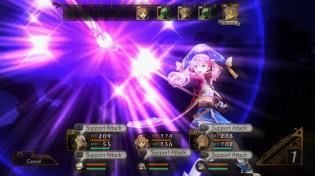
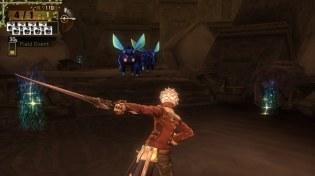
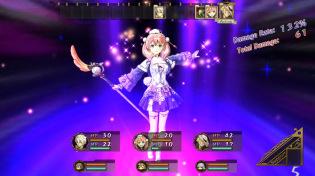
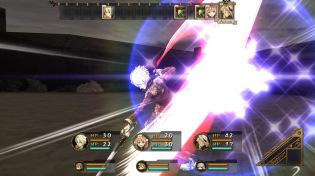
Compared to the other PS3 Atelier games, Escha & Logy is, by far, the most user-friendly and has the best battle system. It almost brings back Mana-Khemia’s battle system by letting 6 characters into the party, with 3 on vanguard and 3 on support, and the ability to switch between the vanguard and support characters. Support actions and turns also play a large role, and the more consecutive ally attacks you execute, the higher the damage bonus. You can also end a long chain of support actions with a powerful attack, but the normal special moves also make a return.
Items also function differently in battle, and I’d say the change is for the better.Each usable item has to be equipped onto an alchemist to be available for use, and each item has a set number of uses that recharge when you return to the atelier. That powerful bomb that you spent an hour trying to stack traits onto? You only need to make it once (or twice if you want more uses at a time)! Each item takes up a certain amount of space on the Adventure Equipment slots, and obviously, you can only equip an item if you have enough space for it. weak bombs and healing items normally only take up one square, whereas that massively powerful end-game book will take up five. You can reduce the amount of space an item takes up with properties acquired through alchemy, as well as increase the number of uses.
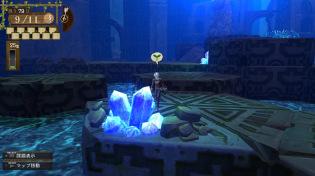
Event-catching and ending management is as smooth as ever, with exclamation marks displayed on areas that have an event (those involving playable characters also have their icon next to it), and the ability to select endings from a list at the end in case you’ve fulfilled multiple ending conditions. Entirely gone are the days where you had to carefully manipulate friendship levels and ending flags to get multiple endings on a single playthrough, and that’s definitely for the better. Speaking of friendship, the friendship values for playable character are hidden, for some lame reason. Perhaps it’s because everyone joins your party so their friendship will automatically increase (vanguards > supports > reserves, in terms of friendship-deepening speed), but nothing beats raw, numeric data in usefulness for the player.
Alchemy is still appropriately complex and engaging, and the battle system has been improved. Yet, there was a sort of empty dissatisfaction I had with the characters. As I played, I realized that my favorite characters were, by far, the returning ones from the game’s predecessor. Linca is the best, as always. But why? That’s because there’s a significant lack of the casual character interaction scenes that were littered all over the Arland trilogy. I had the same problem with Ayesha last year, in that the game simply left me wanting more cutscenes. There were a few events that were really great and entertaining, but those are few and far in between. What I found the most interesting, were the hints and reference to some of the events of the previous game, as well as mentions of its titular heroine and a certain old man alchemist.


As for the more technical stuff, the graphics are an improvement thanks to Tecmo Koei budget. The character models are excellent, and while the environment designs leave much to be desired, there were a few really nice-looking maps. Music is nice but not as good as Ayesha’s. The character design is by Hidari, whose art I’ve really warmed up to, and even prefer to Kishida’s in the Arland trilogy. While the latter has a beautifully soft coloring style, the former’s art really shines in its liveliness and sensible character designs that never look overdone. Overall, I’d say that Escha & Logy’s improvements in the battle system makes it easier to overlook some of its shortcomings in terms of story and character. Being extremely lenient on time, as well as being more combat-oriented while retaining the series’ focus on alchemy, this is a good entry point, and provides enough new mechanics for veterans to enjoy. You can power up the final boss to level 99.
On a side note, the translation job is quite sloppy. Inconsistent use of terms are everywhere (Strong Power vs. Tonic Power, for one), and certain scenes are clearly translated by people who aren’t familiar with the game (Slag—>slug, for one) and didn’t bother studying to try and maintain consistency with previous scripts. It’s far from unplayable, but to pass some of the sub-assignments, you have to try and get into the brain of the translator to figure out exactly which mistranslated item they want from you.