 3 boys image : /www.dulwichpicturegallery.org.uk/
Can You spot the fake? Art gallery replaces Old
Master with £70 version made in China to see if anyone can tell the difference reports Mail Online. When Dulwich picture gallery began discussing
the idea of introducing a fake painting to their collection, no-one could have
imagined it would have led to the quadrupling of visitor numbers.
But that is exactly
what happened when Jean-Honoré Fragonard’s 18th-century work ‘Young Woman’ was
replaced by a hand-painted replica, produced in China and ordered over the
internet for £70. It has hung in among
270 Old Master paintings since February 10 after a challenge was laid down to
the public to 'spot the fake'. Now, three months on, the gallery has revealed
that only 10 per cent of the 3,000 people who visited during the experiment
guessed correctly. But the gallery's chief curator, Xavier Bray, said that he
was impressed a number of people had managed to spot the imposter hidden among
the Rembrandts, Rubens and Murillos. He told MailOnline: 'It was a fascinating
experiment which gave us a chance to test art connoisseurs and we saw visitor
numbers quadruple because of it.
'It made people
look closely at a painting and discern what might be a replica and why. Ten per
cent got it right, which means Britain as a nation is still a nation of
connoisseurs, which is great. 'Unfortunately
others got it wrong. A number of visitors presumed the imposter was a female
portrait by Rubens, which had been restored 10 years ago, because it appeared
brighter. But that was interesting as it allowed us to find out more about the
way the public look at our paintings.'
The idea for the
exhibition, titled Made in China, came from American artist Doug Fishbone. Its
aim was to make people think about the way they look at, appreciate and value
artistic masterpieces. Mr Bray said Dulwich was keen to challenge the public to
'spot the fake' as a way of engaging with visitors and making the picture
gallery more interactive. Bray however
said that the gallery was not planning
any similar experiments. Instead, his attention has turned to whether the fake
will now become a work of art in its own right
'It was a risk, no
doubt about it,' he said. 'You wouldn't expect the National Gallery or the Tate
to display a replica on their walls but because we're an independent charity
and don't rely on public money it means we're relatively free to do what we
want. 'But that doesn't mean there couldn't have been repercussions. We are a
temple of art and as soon as people cross that threshold they expect everything
you are told on a label to be correct. 'Our aim was to get people to engage and
learn - that is what was really exciting. Can they spot a replica by comparing
it with the magical, beautiful originals we have?'
3 boys image : /www.dulwichpicturegallery.org.uk/
Can You spot the fake? Art gallery replaces Old
Master with £70 version made in China to see if anyone can tell the difference reports Mail Online. When Dulwich picture gallery began discussing
the idea of introducing a fake painting to their collection, no-one could have
imagined it would have led to the quadrupling of visitor numbers.
But that is exactly
what happened when Jean-Honoré Fragonard’s 18th-century work ‘Young Woman’ was
replaced by a hand-painted replica, produced in China and ordered over the
internet for £70. It has hung in among
270 Old Master paintings since February 10 after a challenge was laid down to
the public to 'spot the fake'. Now, three months on, the gallery has revealed
that only 10 per cent of the 3,000 people who visited during the experiment
guessed correctly. But the gallery's chief curator, Xavier Bray, said that he
was impressed a number of people had managed to spot the imposter hidden among
the Rembrandts, Rubens and Murillos. He told MailOnline: 'It was a fascinating
experiment which gave us a chance to test art connoisseurs and we saw visitor
numbers quadruple because of it.
'It made people
look closely at a painting and discern what might be a replica and why. Ten per
cent got it right, which means Britain as a nation is still a nation of
connoisseurs, which is great. 'Unfortunately
others got it wrong. A number of visitors presumed the imposter was a female
portrait by Rubens, which had been restored 10 years ago, because it appeared
brighter. But that was interesting as it allowed us to find out more about the
way the public look at our paintings.'
The idea for the
exhibition, titled Made in China, came from American artist Doug Fishbone. Its
aim was to make people think about the way they look at, appreciate and value
artistic masterpieces. Mr Bray said Dulwich was keen to challenge the public to
'spot the fake' as a way of engaging with visitors and making the picture
gallery more interactive. Bray however
said that the gallery was not planning
any similar experiments. Instead, his attention has turned to whether the fake
will now become a work of art in its own right
'It was a risk, no
doubt about it,' he said. 'You wouldn't expect the National Gallery or the Tate
to display a replica on their walls but because we're an independent charity
and don't rely on public money it means we're relatively free to do what we
want. 'But that doesn't mean there couldn't have been repercussions. We are a
temple of art and as soon as people cross that threshold they expect everything
you are told on a label to be correct. 'Our aim was to get people to engage and
learn - that is what was really exciting. Can they spot a replica by comparing
it with the magical, beautiful originals we have?'
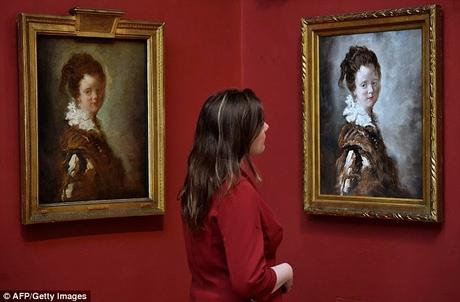 original left and replica right !
The way to
distinguish the real from the fake, Mr Bray said, was to look at the lack of
warmth in the background canvas of the imposter and the modern pigment of
acrylic paints. 'If you look closely, the brushwork on the fake is trying to be
expressive but it comes across as dead because it's an attempt to replicate
something else. There's no magic to it like there is with the real one.' The
original painting was put back in its frame recently and hung beside the
replica, allowing people to compare the differences between the two.
Jean-Honoré
Fragonard’s 18th-century work Young Woman is one of his famous Fantasy Figures,
a series of quickly executed studies intended to showcase the artist’s virtuoso
handling of oil paint. It was painted in 1769. The unidentified woman is
portrayed in Spanish dress, with a lace collar and slashed sleeves suggesting
the dramatic costume of the stage.
With regards – S.
Sampathkumar
original left and replica right !
The way to
distinguish the real from the fake, Mr Bray said, was to look at the lack of
warmth in the background canvas of the imposter and the modern pigment of
acrylic paints. 'If you look closely, the brushwork on the fake is trying to be
expressive but it comes across as dead because it's an attempt to replicate
something else. There's no magic to it like there is with the real one.' The
original painting was put back in its frame recently and hung beside the
replica, allowing people to compare the differences between the two.
Jean-Honoré
Fragonard’s 18th-century work Young Woman is one of his famous Fantasy Figures,
a series of quickly executed studies intended to showcase the artist’s virtuoso
handling of oil paint. It was painted in 1769. The unidentified woman is
portrayed in Spanish dress, with a lace collar and slashed sleeves suggesting
the dramatic costume of the stage.
With regards – S.
Sampathkumar
8th May 2015.