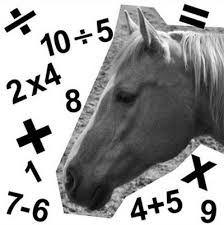
 Around 1900, “Clever Hans” was a famous German horse with seeming mathematical ability. Asked “what is four times three?” Hans would tap his hoof twelve times. He was usually right even when his owner wasn’t present; and even when given the questions in writing!
Animal intelligence — and consciousness — are age old puzzles to us. French philosopher Rene Descartes saw other animals as, in effect, mechanical contrivances. And even today many see all their behaviors as produced
Clever Hans’s story is recapped in Yuval Noah Harari’s book, Homo Deus. It was eventually proven that Hans knew no math at all. Instead, he was cued to stop tapping his hoof by onlookers’ body language and facial expressions. But, Harari says, that didn’t debunk Hans’s intelligence, it did the opposite. His performance required far more brain power than simple math! You might have memorized 4×3=12 — but could you have gotten the answer the way Hans did?
This points up the difficulty of inferring animal mentation using human yardsticks. Harari explains Hans’s abilities by noting that horses, unequipped for verbal language, communicate instead through body language — so they get pretty good at it. Much better than us.

That happened around a couple of hundred thousand years ago. Yet for around 98% of those years, humans achieved little more than mere survival. Only in the last few thousand have we suddenly exploded into a force dominating the Earth as no creature before.
Why that delay? In fact, Harari notes, our stone age ancestors must have been even smarter than people today. After all, their lives were much tougher. One mistake and you’d be dead; your dumb genes would not make it into the next generation.
Harari notes that ants and bees too live in large cooperative communities. So why haven’t they developed computers and spaceships? Our super intelligent consciousness also gave us great flexibility to adapt to changing circumstances. Insects have a far more limited repertoire of responses.