


Scientists following the hole at Copernic Atmospheric Monitoring Service (CAMS) made the announcement late last week, noting that the "rather unusual" hole was not caused by human activity but by a particularly strong Arctic polar vortex, CAMS said.

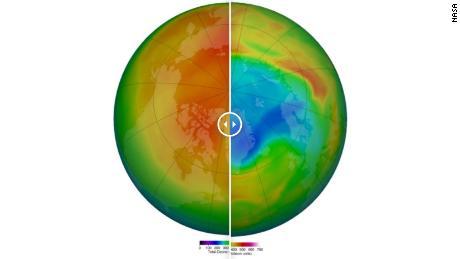
So, despite what you may think, its recovery can probably not be followed until the reduction of pollution due to the coronavirus pandemic.
"COVID19 and associated blockages probably have nothing to do with it", group said on Twitter. "It is driven by an unusually strong, long-lived polar vortex, and is not related to changes in air quality."
Still, the hole was huge - most of the ozone typically found about 11 miles in the stratosphere was depleted, the group said. The last time that such chemical ozone depletion was observed in the Arctic occurred almost a decade ago.
A polar vortex is a large area of cold, low-pressure air that surrounds the Earth's two poles, according to the National Weather Service. Polar vortices still exist, but they generally weaken in summer and strengthen in winter. The polar vortex in the Arctic is generally weaker due to the presence of nearby lands as well as mountain ranges that disrupt the weather more than its southern counterpart, CAMS said.

The ozone layer is located 9 to 22 miles above the Earth. It protects us from ultraviolet rays.
Unlike the hole that developed over the Arctic, the Antarctic ozone hole in the southern hemisphere is usually caused by chemicals such as chlorine and bromine migrating into the stratosphere. This has caused an ozone hole in Antarctica every year for the past 35 years.
There was also good news: last year, the Antarctic ozone hole was at its smallest since its discovery.
CAMS does not expect the ozone number to return to the extremely low levels recorded in early April, providing a little hope in these dark times: the ozone layer heals slowly, one way or another.
Scottie Andrew of CNN contributed to this report.






