This book came along at just the right time for me, and was exactly what I needed. I’ve been struggling with my Jewish identity since the events of October 7, 2023 and since my father’s passing in December 2024. I hate what Israel is doing in Gaza, but I’m terrified of the growing antisemitism towards Jews and Israel, and the ways in which the Trump administration are using and aggravating those biases. I was looking for a way to sort through my conflicting feelings, and this book helped.
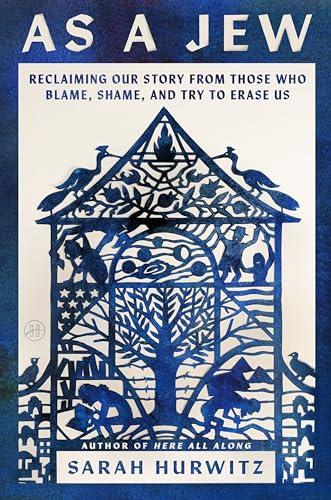
Sarah Hurwitz, a speechwriter for President Obama and First Lady Michele Obama, considered herself a “cultural Jew”. She was raised with the basics of the religion, went to Hebrew school, had a Bat Mitzvah, and lived among enough other Jews that she didn’t feel “other”. At 36, she attended a class on Judaism at the DC Jewish Community Center, which encouraged her to study Jewish texts and explore her spirituality and the history of Judaism.
She begins this book with a discussion of why so many Jews try to explain away their Jewish identity. What does it mean to say “I’m only a cultural Jew” (are you still a Jew?) Are we somehow embarrassed or ashamed of Judaism, regardless of whether we believe in God? Do people of other religions do the same thing, or is there something different about being Jewish?
I’ve had trouble putting all this into words for myself, so I appreciated Hurwitz for doing so, and prompting me to think through my own relationship with Judaism. In many ways, my upbringing was similar to Hurwitz, but with a few key differences. My father was a Holocaust survivor, a refugee from Slovakia who grew up in Israel. He lived through much of the history Hurwitz describes about the creation of Israel, and was there for the day of Israel’s independence. My father’s wife was also raised in Israel, and she raised her children there as well, so I now have close ties to the country.
And unlike Hurwitz, I definitely felt “othered” growing up as a Jew. We moved from New York City to Phoenix when I was young, and while Phoenix has a large Jewish population, our neighborhood and school did not. Taking off for the religious holidays without missing important schoolwork always felt like a battle, and my interactions with other Jews mostly occurred through youth groups outside of school. I encountered anti-semitism, not frequently, but I remember those incidents well.
I’ve never considered myself religious, but my Bat Mitzvah was important to me — not for the party or gifts, but for the actual study. I was that kind of kid. I loved that Judaism encouraged us to think and study and question. I remember getting up in front of the congregation and talking about what reading meant to me. I loved learning another language and thinking about what the words meant. I’ve always thought, if I could have chosen a religion, Judaism is what I would have chosen. I like the ideas of Judaism, about helping others and about grounding your deeds in today, rather than a future in Heaven.
While Hurwitz begins with the personal, she then shifts to an extensive exploration of Jewish history, from antiquity to the Holocaust, to the creation of Israel to the events of today. Importantly, she creates a framework that explains the recurrence of antisemitism across so many years and cultures. She explains that throughout history, Jews have been disparaged for their power, depravity and conspiracy. Hurwitz studied the writings of early church leaders who sought to distinguish Christians from Jews, and found this pattern:
They claimed that Jews are overwhelmingly, disproportionately, preternaturally powerful – so powerful they got the Roman conquerors to do their bidding. They claimed that Jews are sickeningly, diabolically depraved – so depraved that they killed God’s Son, whose blood is on the hands of every single Jew for all time; so depraved that they are children of the devil. And they claimed that Jews are in a conspiracy – constantly working together behind the scenes to hurt others (e.g., Jesus) and benefit themselves.
Hurwitz spends a lot of time on the history of Arab-Jewish conflict. She acknowledges that the actions of Israel towards Gaza are problematic, but worries that people are not taking into account the full history of the conflict, and that they are too quick to call for Israel’s elimination or to blame all Jews rather than criticizing actions of the current Israeli government.
When the world seems overwhelming, it’s comforting to think you have it all figured out. And viewing Israel through a simplistic right-versus-wrong framework, such that you feel you’re on the “right side of history” is much more satisfying than contending with the torturous complexity of an intractable conflict.
There is so much in this book, it’s difficult to describe it in one review. I appreciated Hurwitz’ extensive research and comprehensive approach. I learned many new things and gained a much greater understanding of the Talmud and how Jews have studied, built on, and adapted Jewish principles. This book is an excellent companion to Chaim Potok’s novel The Chosen, which delves into both Jewish scholarship and Zionism. I highlighted many passages in the book and I know I’ll be recommending this book frequently, to Jews and non-Jews. I’ll leave you with this quote.
I did not want to think about how this conception of Jews has shaped how others view me and how I view myself. It was almost easier to believe that antisemitism is a mystery or that Jews have done something to deserve it. If we’re doing something wrong, in theory, we can change… It’s more pleasant than acknowledging that all of this history is finally catching up to many of us who thought we were Jews outside of history. And it’s more pleasant than accepting that there is no such thing as a Jew outside of history.
Note: I received an advanced review copy of this book from NetGalley and publisher Harper One. This book published September 7, 2025.