


It is fitting, though perhaps somewhat disappointing, that when Mark Zuckerberg, Jeff Bezos, Tim Cook and Sundar Pichai come together for a highly anticipated congressional hearing on Wednesday, it will be via video chat.
Silicon Valley technology has changed the world and allowed people around the world to stay connected even during an unprecedented pandemic. However, the success of Facebook, Amazon, Apple, and Google's parent company Alphabet - and the four men who run these companies - has led to another unprecedented phenomenon: the amazing control Silicon Valley has over what the world reads, buys and makes online.
How much control? Facebook is the world's largest social network with a user base that roughly corresponds to the two most populous countries in the world. Amazon controls 38% of U.S. online sales - Walmart, its closest competitor, had barely 6% - and has data on other retailers using the huge platform. Apple's App Store is a powerful gateway for software developers to find an audience with the company's huge iPhone and iPad customer base. And Google processes about 90% of all web searches worldwide.
The hearing, which has been postponed for two days to erect a memorial to late MP Lewis, is the first time that lawmakers have had the opportunity to grill the CEOs of these four powerful companies at the same time. Officially, the subject of antitrust law is the culmination of a more than one-year investigation into the dominance of big tech by a subcommittee of the House Justice under the leadership of Rep. David Cicilline (pictured above), a Rhode Island Democrat. During this time, the subcommittee collected more than 1.3 million documents from technology giants, competitors and antitrust authorities for the investigation.
However, politicians are known to deviate from the script, and the hearing is expected to become free for everyone and address issues as diverse as election security, political bias, and relations with China.
Government officials have struggled with the power of technology companies for decades. In 1984, AT&T was split into eight separate companies. Microsoft, the technology industry's original villain, was accused of having a monopoly on PC software in the 1990s, a milestone that led to an agreement in 2001. The European Union also forced Microsoft to open its operating system to competitors and repeatedly fined it. However, industry-wide billing, which is the hearing, is new territory.
The hearing is a rare public consultation of key big tech executives at a crucial time. The US presidential election is just around the corner, the country is struggling with social upheavals for racial injustice, and the world is staring at deadly contagion. Meanwhile, Americans are using Tech's services and devices to find information online, buy supplies, and download and stream entertainment while protecting themselves locally.
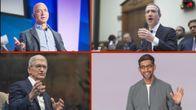
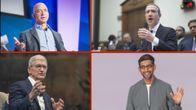
"They all control dominant platforms," said Hal Singer, a senior researcher at the George Washington Institute of Public Policy, referring to the companies. "This is a good opportunity to bring them all together and see if there are any patterns."
Separate battles
Each of the four companies faces its own cartel fight. All of them are reportedly targeted by Ministry of Justice probes or a coalition of attorneys general. Google and Facebook have confirmed various investigations, while Amazon and Apple have not publicly recognized them.
With Facebook, which reports second quarter earnings on the same day as the hearing, regulators are reviewing the company's acquisitions of competitors like Instagram and WhatsApp. For Amazon, the congress has largely focused on the company's private label business, which sells Amazon brands for clothing, food, and consumer goods such as batteries and diapers. Apple has taken a close look at the cut in software developers in its app store. For Google, regulators mainly focus on the search giant's dominance in digital advertising.
At Wednesday's hearing, all of these different threads will cross like a very shaky and nerdy crossover episode. The Republicans have also asked Twitter CEO Jack Dorsey to attend the hearing after a massive security breach occurred earlier this month. Dorsey is not on the witness list.
Bezos' newcomer status is added to the intrigue. Zuckerberg, Pichai and Cook have all testified before. (Zuckerberg, the youngest of the group, has the most experience on Capitol Hill. In 2018, after the Cambridge Analytica data scandal, he asked questions in two sessions for almost ten hours over two days. He also said on Facebook's planned Libra cryptocurrency last year. )
Despite its growing profile - and wealth - Bezos has never seen Congress. Last Monday the The wealthiest person in the world grew by $ 13 billion in one day alone, he brought his total net worth to nearly $ 190 billion.
Bezos can have an uncomfortable day. President Donald Trump has made personal recordings with the Amazon chief, apparently due to coverage by the Washington Post, which Bezos owns separately from Amazon. Republicans allied with the president are likely to pick up the baton and run with it. But there are also legitimate questions about Amazon's size and business practices.
A virtual matter
All of the top-class hearings in Congress are partly political theater, full of pomp and spectacle. When Zuckerberg testified before the congress two years ago, a group of activists set up 100 cardboard cutouts from Facebook's CEO on the lawn of the Capitol building and begged him to "repair the fake book". Protesters dressed as rabbits and superheroes sang slogans like "Zuckerberg, you are absurd!" After he sat down for his first hearing, photographers took pictures of him for almost a full minute before proceeding further.
The circus doesn't follow the young Mughal on Wednesday. The event will be carried out virtually, an adaptation to the house rules due to the coronavirus pandemic. That means the hearing will lack the drama associated with personal visits to DC Cutting exchanges, which Rep. Katie Porter's Zuckerberg needling about his hairstyle is unlikely to play last year. Fast timing is difficult to perfect with zoom.
Some observers have criticized the format of the forum. When all four CEOs appear at the same time, they each spend a fraction of the time in the hot chair. Attention would be more focused if everyone testified individually.
The hearing can be more show than substance. The actual developments will come later. A landmark case against Google is expected to be filed this summer. Facebook is waiting for the results of several probes, including one from the Federal Trade Commission. The hearing is therefore unlikely to play a critical role, even if it gives CEOs the opportunity to publicly defend their companies.
People who are following the hearing should lower their expectations, says David Balto, a former lawyer from the Department of Justice's anti-trust department, whose clients include technology companies. In these situations, legislators can only achieve so much, and Congress should focus on getting companies to publicly commit to reforming their competitive practices. That would mean, for example, getting Zuckerberg to commit to major acquisitions that "consolidate" the industry, such as taking over Instagram.
"The hearing is extremely important," said Balto. But "be ready for disappointments," he adds, when you're looking for big changes.
CNET's Ben Fox Rubin, Queenie Wong and Ian Sherr contributed to this report.





