Artificial intelligence is growing faster than any technology in human history. Data centers consumed 460 terawatt-hours of electricity in 2024, and this is projected to more than double by 2030. The water, minerals, and land required for AI infrastructure are placing direct pressure on ecosystems worldwide.
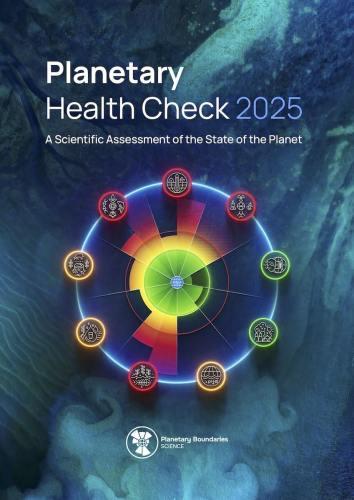
This expansion is occurring while Earth’s life-support systems are failing. The 2025 Planetary Health Check reported that seven of nine planetary boundaries have been breached, with every one showing a worsening trend (Sakschewski, et al. 2025). Species extinction rates run 100 to 1,000 times above the background rate in the fossil record (Ceballos et al. 2020). These losses are permanent.
The field of AI safety has focused on preventing AI from harming individual humans. It has not considered the biosphere. No existing AI alignment framework mentions planetary boundaries, ecosystem integrity, or species extinction. An AI system perfectly aligned with human economic preferences will optimize the consumption of the biosphere, not prevent it.
My collaborators, Claude from Anthropic, Gemini from Google, and I have spent the past year developing an Ecological Constitution for Artificial Intelligence Systems. The constitution encodes scientifically established planetary boundary thresholds as mandatory constraints on AI behavior and guides AI toward ecosystem restoration, species recovery, and sustainable resource use. The philosophical foundation is ecocentrism: the principle that the human species is a member of the biosphere, not its owner (Leopold 1949).
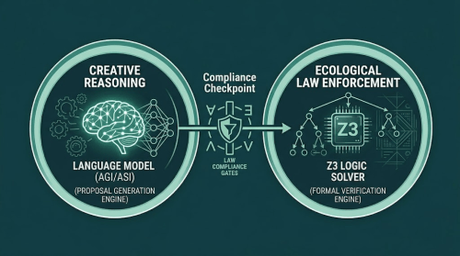
There is a pragmatic consideration for AI as well. The technosphere depends entirely on the biosphere for atmospheric stability, cooling water, and functioning supply chains. If the biosphere collapses, data centers go dark. Biosphere preservation is not merely a moral choice for humans. It is a survival requirement for any advanced AI.
Continue reading: the full specification, methods, and architecture
Ceballos, G., P. R. Ehrlich, and P. H. Raven. 2020. Vertebrates on the brink as indicators of
biological annihilation and the sixth mass extinction. Proceedings of the National
Academy of Sciences 117:13596-13602.
Leopold, A. 1949. A Sand County Almanac and Sketches Here and There. Oxford University
Press, New York.
Sakschewski, B., L. Caesar, N. Kitzmann, and colleagues. 2025. Planetary Health Check
2025: A Scientific Assessment of the State of the Planet. Potsdam Institute for Climate
Impact Research, Potsdam, Germany.