


President Donald Trump first met with Prime Minister of Canada Justin Trudeau on Monday.
"We have a very exceptional trading relationship with Canada," said Trump at the press conference.
But the trade relationship between the United States and Canada over the years has not been as fluid as you might think. There have been trade wars, reprisals, allegations of dumping and job losses.
"Our commercial relationship is obviously solid ... but the relationship was difficult, despite the agreements we have in place," says Stuart Trew, editor-in-chief of the Canadian Center for Policy Alternatives, a research group in Ottawa, the capital. from Canada.
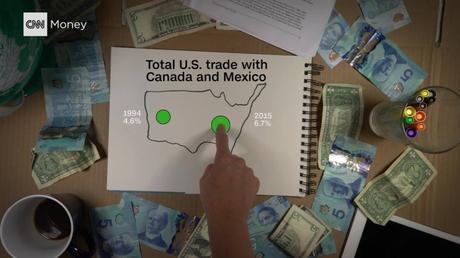
America and Canada have one of the most important trading relationships in the world.
Trump has often criticized Mexico and NAFTA, the trade agreement between the United States, Mexico and Canada. But Canada is rarely mentioned.
Yet there have been more NAFTA claims against Canada - almost all by US companies - than against Mexico. Even today, Canada has tight tariffs against the United States, and the two sides only recently resolved a bitter meat dispute.
Most leaders and experts stress that the commercial ties between the two nations are strong and above all positive. But Canada and America have had many battles along the way.
Now Trump wants to renegotiate NAFTA, which will be at the top of the agenda for his meeting with Trudeau.
1. Canada has more problems with NAFTA than Mexico
Listening to Trump, you might think that Mexico is the bad player in NAFTA. But since the creation of NAFTA in 1994, 39 complaints have been brought against Canada, almost all by American companies. Known in the industry as investor-state dispute resolution, it allows companies to resolve cases under a special panel of NAFTA judges instead of local courts in Mexico, Canada or the United States. .
There were only 23 complaints against Mexico. (In comparison, companies in Mexico and Canada have filed a total of 21 complaints against the United States.)
And more and more, Canada is the target of American complaints. Since 2005, Canada has been affected by 70% of NAFTA-related disputes, according to ACCP, a Canadian research firm.
2. The US-Canada Softwood Lumber Battle
NAFTA is not the only pain zone. In 2002, the United States imposed a tariff of approximately 30% on Canadian softwood lumber, alleging that Canada "dumped" its lumber into the United States market. Canada denied the request and argued that the tariff cost its lumber companies 30,000 jobs.
"It was a very bitter point in Canada-US relations for quite a while," said Tom Velk, professor of economics at McGill University in Montreal.
The dispute originated in the 1980s, when American lumber companies said their Canadian counterparts were not fair.
Whether Canada has actually broken the rules is controversial.
Canadian officials deny that the government subsidizes softwood lumber companies in Canada. US softwood lumber companies still claim this to be the case, and a report by the United States Department of Commerce found that Canada provided subsidies to logging companies in 2004. It did not say whether the subsidies were in effect. Classes.
Allegedly, Canada has subsidized lumber companies because the government owns a lot of the land from which the wood comes. This subsidy - in addition to Canada's huge supply of lumber - has allowed Canada to price its lumber below what American companies can charge.
The World Trade Organization finally sided with Canada, denying America's claim, and the two sides reached an agreement in 2006 to end the tariff.
However, this agreement and the ensuing grace period expired in October, and both parties are back. The Obama and Trudeau administrations did not reach a compromise before Obama left, and this remains a contentious business problem with the American lumber companies, which are again demanding tariffs.
Related: "Without NAFTA", We Would Be Bankrupt
3. Smoot-Hawley unleashes a trade war between the United States and Canada
Things got worse during the Great Depression. In 1930, Congress wanted to protect American jobs from world trade. The United States has therefore imposed tariffs on all countries that ship goods to America in order to protect workers.
It was called the Smoot-Hawley law. Today, it is widely believed that this law worsened the Great Depression.
Canada was furious and fought back more than any other country against the United States, unleashing a trade war.
"Canada was so exasperated ... that it raised its own tariff on certain products to match the new American tariff," said Doug Irwin, professor at Dartmouth and author of "Peddling Protectionism: Smoot-Hawley and the Great Depression" .
For example, the United States increased the tariff on eggs from 8 cents to 10 cents (these are the prices of the 1930s, after all). Canada responded by also raising its tariff from 3 cents to 10 cents - an increase of three times.
Exports fell sharply: in 1929, the United States exported nearly 920,000 eggs to Canada. Three years later, he only shipped about 14,000 eggs, according to Irwin.
Related: Remember Smoot-Hawley: America's Last Great Trade War
4. Canada's high tariffs on eggs, poultry and milk in the United States
Fast forward to today. Smoot-Hawley is long gone, but Canada continues to charge high tariffs on US imports of eggs, chicken and milk.
For example, some egg prices can reach 238% per dozen, according to the Canadian Department of Agriculture. Certain imports of milk, depending on the fat content, can reach 292%.
"They are so expensive that you cannot bring them. There are no American eggs in Quebec, "explains Velk.
According to the Embassy of Canada to the United States, the reality is very different. Officials say that despite tight tariffs, Canada is one of the major export markets for US milk, poultry and eggs.
The United States has tariffs on certain products from all countries, but they are not as high as those of Canada.
Experts say these tariffs continue to frustrate some American dairy and poultry producers, some of whom are struggling to sell on the Canadian market. But they doubt that much will change since the tariffs have been in place for decades now.
Related: These Reagan Pricing Trump Likes To Talk About
5. COOLer heads and the future of NAFTA
Despite all these disputes, experts point out that this business relationship is still one of the best in the world.
In fact, the two countries are so interconnected now, when trade disputes sometimes arise, American companies side with Canadian companies and against American lawmakers.
For example, Canadian meat producers challenged a US law that required them to label the place of birth, raising and slaughter of livestock. Canadians have said the law discriminates against selling their meat to the United States and have taken the matter to the WTO.
The WTO has taken sides with Canada and, last December, Congress repealed the country of origin labeling law. American meat producers - whose activities are closely related to Canada - actually supported their counterparts in Canada, arguing that the regulations were too restrictive.
As for Trump's proposal to tear up NAFTA, many American and Canadian experts say it is not worth renegotiating or ending the agreement. The three countries that are part of the agreement are so linked to each other that untangling all of this integration would be detrimental to trade and economic growth.






