


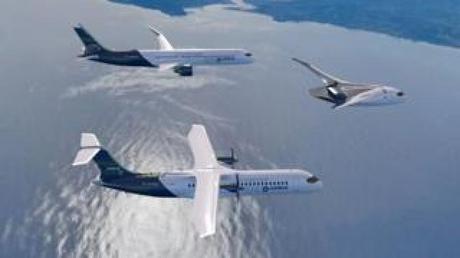
Aerospace giant Airbus has unveiled plans for what it hailed as the first zero-emission commercial aircraft.
It said its hydrogen-powered passenger planes could be in service by 2035.
Airbus CEO Guillaume Faury said the three ZEROe concept designs marked "a historic moment" for the commercial aviation industry. "
The use of hydrogen had "the potential to significantly reduce the climate impact of aviation," he added.
However, analysts point out that this isn't the first time hydrogen has been touted as the savior of modern air travel.
The history of aviation fuel dates back to the days of airships in the early 20th century, but the Hindenburg disaster in 1937 put an end to that era.
More recently, from 2000 to 2002, Airbus was involved in the EU-funded Cryoplane project, which investigated the feasibility of a liquid hydrogen-powered aircraft.
After that, the idea fell out of favor again, until now.
"Decisive action"
Unveiling its latest designs, Airbus said its turbofan design could carry up to 200 passengers for more than 2,000 miles, while a turboprop concept would have 50 percent less capacity and range.
A third "blended-wing body" aircraft was the most eye-catching of the three designs.
All three planes would be powered by modified gas turbine engines to burn liquid hydrogen and through hydrogen fuel cells to create electricity.
However, Airbus admitted that for the idea to work, airports would have to invest large sums of money in refueling infrastructure.
"Switching to hydrogen as the primary energy source for these airplanes will require decisive action from the entire aviation ecosystem," said Faury.
"Together with the support of the government and industrial partners, we can rise to this challenge to increase renewable energy and hydrogen for the sustainable future of the aviation industry."
The new Airbus models are the result of a joint research project that Airbus launched with EasyJet last year to consider hybrid and electric aircraft.
The airline's chief executive, Johan Lundgren, said: "EasyJet remains absolutely committed to a more sustainable flight and we know that technology is where the answer for the industry lies."






