


Airbnb filed to go public today, taking the famous unicorn one step closer to being a public company.
Financial results show a company recovering, but smaller than before. Its more granular financial results also make it clear how hard the pandemic has been for the travel-addicted unicorn. When it comes to Airbnb's value, investors will need to balance how they view the recovery and recent profits against the company's historic disrupted growth span.
How did we get here?
The home-sharing startup had a tumultuous year, with the COVID-19 pandemic damaging its business in the first and second quarters of the year, and Airbnb later recovered thanks to more local bookings.
His filing comes just days after the same unicorn fellow DoorDash and C3.ai showed up on the stock exchange in what could be a rush to public markets by highly valued startups.
Airbnb's S-1 filing was supposed to arrive last week, but was delayed due to alleged election concerns, a concept ProWellTech staff did not find entirely convincing.
We've gathered a lot about Airbnb's recent financial performance, but its S-1 is the real treasure. What follows is a dip into the company's top-tier numbers. From there, ProWellTech will delve into the financial nuances and ownership stakes of the company.
The financial performance of Airbnb
What we want to know is the impact of the pandemic on Airbnb's operations; its results since the beginning of the year and what we can find out from its quarterly trends.
At the top of Airbnb's S-1 is a chart showing monthly bookings on its platform. The implication is quite simple; that is to say, Airbnb knows what we want to know and what we wanted to share. Here are those numbers:

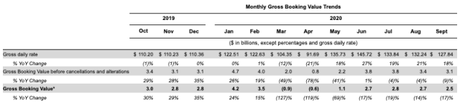
As expected, Airbnb experienced huge success in March. But by May, things were back to year-over-year growth, where they had remained.
Now, the company has seen a small growth in valuable bookings since June, indeed it has seen bookings decline in the following months. And even worse, the company's gross bookings after the removal of cancellations fell year-on-year. (To update: We misread this table at first and updated our notes on it.)
So what does this look like in more traditional accounting data? Here is Airbnb's reported income statement:


As expected, Airbnb's year wasn't great. In fact, the company is well on its way to matching the size of 2018, if our calculations are correct.
What has changed from the first three quarters of 2019 to the first three quarters of 2020? Most important, aside from the expected reduction in revenue costs - minus revenue costs minus - is the huge drop in the company's sales and marketing expenses. Airbnb cut S&M spending from $ 1.18 billion in the first three quarters of 2019 to just $ 545.5 million in the same period of 2020.
So where will Airbnb go in 2020 once it's all over? We'll have to take a look at his quarterly results for that. Here they are:


Airbnb's growth continues on an annual basis until the quarter of March 31, 2020, when it was effectively unchanged from the first quarter of 2019. Or, the company would have grown without COVID-19. In the quarter of June 30, 2020 we see the real damage, with Airbnb's revenue dropping from $ 1.2 billion in the quarter a year ago to just $ 334.8 million. It's a shocking drop.
But, looking at the third quarter of 2020, we see a great return to shape. Yes, Airbnb's third quarter was lower than the third quarter of 2019, with $ 1.34 billion in revenue instead of $ 1.65 billion in 2019, but the company actually quadrupled from the previous quarter. If the company were managing another third quarter revenue value in the fourth quarter, it would be a few hundred million higher than in 2018.
Basically, Airbnb managed to go from a number of unprofitable quarters to a profit in the third quarter, similar to the third quarter of 2019 when it was also in the black. Obviously, Airbnb's $ 219.3 million GAAP net profit during the third quarter pales compared to the losses recorded earlier in the year. The company will not break even in 2020.
Airbnb also reported adjusted profit metrics. The results of Adjusted EBITDA are based on the following definition:
Adjusted EBITDA is defined as adjusted net profit or loss for (i) provision for income taxes; (ii) interest income, expense and other income (charges), net; (iii) depreciation and amortization; (iv) share-based compensation expenses; (v) net changes to lodging tax reserves for which we may be jointly and severally liable with hosts for the collection and payment of such taxes; and (vi) restructuring charges.
The decision to remove the renovation costs raised eyebrows, with Amy Cheetham, a Costanoa Ventures investor saying that "Does it seem like neglecting renovation costs is a bit aggressive?" We agree, as it gives the company too much flexibility to count good in its results, such as lower operating costs, while discounting what it took to achieve those results, such as restructuring its business operations.
It's having your cake and eating it too is not counting calories.
However, who are we to hold back the numbers? here is the file very Adjusted EBITDA reported by Airbnb:


The numbers are still not good even after snatching so many costs. Worse still, perhaps it is the company's cash burn over the year. This deficit helps explain why Airbnb hired more capital when it did so earlier this year.
It's hard to rate this S-1 firmly. It contains what we expected, but how investors weigh the company's decline in revenue in Q3 2020 versus its rapid return from Q2 2020 should help decide its ultimate value. Overall, Airbnb has managed to do something incredibly impressive: bounce back from so low to so low.
But now that it's going public we can't just say good work; he wants to value himself well and trade strongly. So, all eyes on its first range of IPOs should tell us what investors might be willing to pay for the capital of the famous company.






