


In a primary care practice with a value-based care contract, preparing for a visit can mean checking lab results, specialist notes and pharmacy records.
Someone still has to gather that information and route it for review.
AI tools now take on parts of that work in risk adjustment.
The useful question is not whether a tool uses AI but which step it handles, what it needs as input and who signs off on the result.
Key Takeaways
- Check every suggested code against the chart evidence behind it.
- Evaluate pre-visit preparation, retrospective review and audit response separately, since each has its own inputs and sign-offs.
- Assess how a tool changes both clinical and administrative work, as AHRQ recommends for health IT.
- Plan for the CMS change that removes most unlinked chart review diagnoses from risk scores starting in 2027.
Where AI Fits in Risk Adjustment
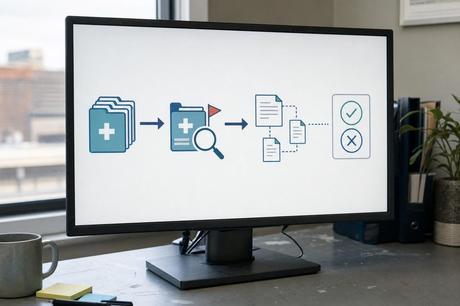
Risk adjustment uses documented diagnoses to estimate the expected cost of caring for a patient population and to inform payment.
Hierarchical condition categories (HCCs) group diagnoses with similar cost patterns. The information needed is often spread across the electronic health record (EHR), claims and lab systems, so it helps to map the data flow before adding any tool.
Hierarchical condition categories (HCCs) group diagnoses with similar cost patterns. The information needed is often spread across the electronic health record (EHR), claims and lab systems.
An AI tool can collect records, flag passages that may support a condition and log a reviewer’s decision. During evaluation, check where the software’s role ends and who takes the next step.
The split of responsibility should stay clear. A clinician decides whether a condition is present and documents it.
A coder assesses whether that documentation supports a code, and the tool should record who made each decision.
Before the Visit
Pre-visit work draws on charts, claims and lab results for scheduled patients.
The goal is a short summary that helps the physician address chronic conditions and suspected gaps during the appointment.
In a demonstration, ask to see how a reviewer prepares that summary and checks the passages behind it. Treat a suspected condition as a prompt for clinical assessment. It should pass through review before it ever becomes a submitted code.
After the Encounter
Retrospective review starts with documentation from completed visits.
The key test here is evidence traceability: can a reviewer open the exact passage behind each suggested code and judge its relevance?
Check how a coder accepts, rejects or escalates a suggestion. Look for two-way review as well, meaning the tool flags unsupported codes for removal and not only missed diagnoses.
Traceability helps reviewers work faster, but it does not prove coding accuracy on its own.
Preparing an Audit Response
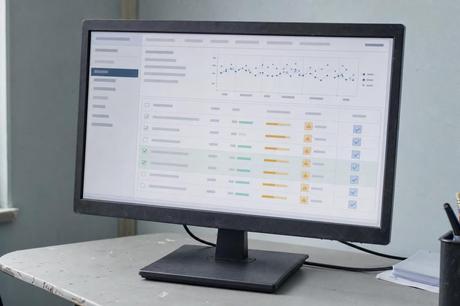
Risk Adjustment Data Validation (RADV) is the CMS process for checking whether diagnoses submitted for Medicare Advantage payment are supported by medical records. On August 28, 2026, CMS released its audit methods and instructions for payment year 2024 contracts.
For audit work, the inputs are the specific charts and codes under review. Ask how a tool organizes records, flags documentation gaps and tracks what was sent. Your compliance lead and coders decide what the evidence supports, and no tool guarantees an audit outcome.
How Vendors Divide the Work
Vendors package these steps differently, so match each offering to the work your team actually does.
For example, RAAPID’s risk adjustment solutions cover prospective review, retrospective chart review and RADV audit support.
Its pre-visit product analyzes charts, claims and lab reports to build a summary before the encounter.
Its retrospective workflow ties each HCC to MEAT evidence (monitor, evaluate, assess and treat), and an AI as a Service option offers API integration with existing systems.
Other vendors cover different combinations of this work. Cotiviti offers prospective, concurrent and retrospective programs, and Datavant provides first-pass coding plus second- and third-level review.
Navina’s point-of-care tool integrates bidirectionally with the patient record, while Reveleer’s retrospective coding adapts in real time to coder HCC validation.
What to Test in a Pilot
AHRQ’s workflow assessment toolkit advises mapping proposed workflows before a health IT system goes live. Define the steps, inputs and owners first, then test the tool against them.
Evidence. Ask for a demonstration on an approved, representative sample of your own charts. Confirm that reviewers can see the source passage and record their decision.
Integration. Check which input formats the tool accepts, how it connects to your EHR and what it writes back. Test what happens when a transfer fails and how staff continue the work manually.
Human review. Confirm who accepts or rejects each suggestion and where that decision is logged. In a 2026 survey of 200 senior U.S. payer and provider decision-makers, conducted by The Harris Poll for Reveleer, only 35% of organizations reported a documented process for catching incorrect AI output. Write yours down before launch.
Privacy. Involve your privacy or security lead early. HHS states that business associates are directly liable for compliance with certain HIPAA requirements, which matters whenever a vendor handles patient records.
Pilot measures. Track review time including corrections, the share of suggestions that lacked support, exceptions handled and work completed. These are suggested pilot measures, not benchmarks. They show whether the tool cuts total work while keeping documentation quality intact.
The 2027 Chart Review Change
For calendar year 2027, CMS is excluding diagnoses from unlinked chart review records from risk score calculation.
These are diagnoses not tied to a specific beneficiary encounter. The exception covers beneficiaries who switch from one Medicare Advantage organization to another.
Ask any vendor how its tool links findings to encounters and how it handles that exception. Request an itemized proposal that separates software, integration and human review services so you can compare it with the scope tested in your pilot.
Keep Ownership Clear After Launch
AI can shorten the path from scattered records to a reviewed code, but clinicians and coders still own the decisions. AHRQ also notes that health IT can keep informing workflow improvements once it is in use.
Assign an owner to track review time, corrections and unresolved exceptions after go-live. Give that person a clear route to the responsible clinician or coder.
FAQs
Can AI assign HCC codes without a coder?
Tools can suggest codes and surface supporting text. A coder still confirms whether the documentation supports each code, and the clinician remains responsible for the diagnosis.
What is an unlinked chart review record?
It is diagnosis information from a chart review that is not tied to a specific beneficiary encounter. Starting in 2027, CMS excludes these diagnoses from risk scores except for beneficiaries who switch Medicare Advantage organizations.
What should a RADV-focused tool help with?
It should organize the requested records, flag documentation gaps and keep a record of what was submitted. Final judgments on whether evidence supports a code stay with your compliance and coding staff.
How should a pilot be measured?
Track review time including corrections, unsupported suggestions, exceptions handled and work completed. Compare those results with your current process rather than with vendor benchmarks.





