Customer support has always been about one thing: helping people when they need it. But the way businesses deliver that support is changing quickly.
A few years ago, having a phone number, email address, and live chat team was enough to provide a reasonable customer experience. Today, customers expect much more. They want quick answers, 24/7 availability, personalized assistance, and ideally, a solution without having to repeat their problem to three different agents.
This is where AI chatbots are making a noticeable difference.
For businesses, however, the decision isn’t simply about adopting the latest AI technology. It comes down to a much more practical question:
Does an AI chatbot actually provide a better return on investment than traditional customer support?
The answer can be yes—but only when the technology is implemented around the right business problems.
Let’s take a closer look.
Traditional Customer Support: Reliable but Expensive to Scale
Traditional customer support has one major strength: people understand people.
A trained support agent can listen to a frustrated customer, understand context, show empathy, and make a judgment call when a situation doesn’t fit neatly into a predefined process. That’s something technology still can’t replicate perfectly.
But traditional support has another side. It is expensive to scale.
Every additional customer interaction requires some level of human capacity. As ticket volumes increase, businesses may need to hire more agents, extend working hours, provide additional training, and invest in supervisors and quality assurance.
The cost isn’t limited to salaries either. Companies also spend money on:
- Recruitment and onboarding
- Training
- Customer support platforms
- Contact-center infrastructure
- Workforce management
- Quality monitoring
- Overtime
- Employee turnover
- Management and administration
The problem becomes particularly obvious during busy periods.
Imagine an online retailer running a major holiday promotion. Customer inquiries suddenly double. Customers want to know where their orders are, whether products are in stock, how returns work, and when deliveries will arrive.
The company can’t simply double its support team overnight. That’s where automation starts to make economic sense.
AI Chatbots Change the Economics of Support
An AI chatbot can handle thousands of customer conversations without requiring a human agent for every interaction.
It can answer common questions, help customers find information, track orders, explain policies, collect information, and route complicated issues to the appropriate employee.
More importantly, it can do this around the clock. A customer doesn’t have to wait until Monday morning to ask a simple question. This creates a different support model:
Traditional support: More customers generally mean more support staff.
AI-assisted support: More customers can often be handled with significantly less additional human capacity.
That doesn’t mean businesses should eliminate their support teams. In fact, the better approach is usually to let AI handle repetitive work while human agents focus on conversations that genuinely require human judgment.
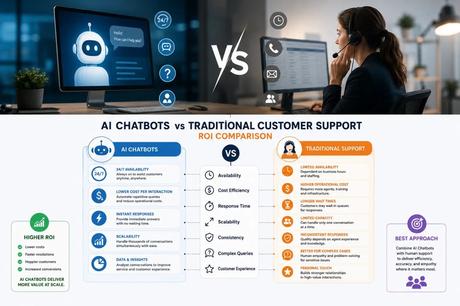
AI Chatbots vs Traditional Customer Support: A Practical Comparison
FactorTraditional SupportAI Chatbots
AvailabilityUsually business hours or shifts24/7
Response timeDepends on queue sizeUsually immediate
ScalabilityRequires additional staffHighly scalable
Repetitive questionsTime-consuming for agentsEasily automated
Complex problemsExcellentHuman escalation recommended
Emotional conversationsStrongLimited
Concurrent conversationsLimited by staffingCan handle many simultaneously
Cost per repetitive interactionHigherPotentially much lower
Customer dataOften spread across systemsCan be centralized and analyzed
Peak-period supportRequires workforce planningEasier to scale
PersonalizationDepends on agent and systemsCan be data-driven
The important point is that this isn’t necessarily an “AI versus humans” situation. The strongest model is often AI plus humans.
Understanding the Real ROI of an AI Chatbot
When companies calculate chatbot ROI, they often focus only on how many employees they can replace. That’s too narrow.
A good AI chatbot can generate value in several different ways.
For example, it can reduce:
- Number of tickets reaching human agents
- Average handling time
- First response time
- Customer service backlog
- Overtime requirements
- Cost per interaction
But there can also be revenue-related benefits. A chatbot can help customers choose products, answer pre-purchase questions, recommend relevant products, recover abandoned purchases, and guide users through checkout.
So the ROI calculation should include both cost savings and revenue impact.
A simple formula is:
AI Chatbot ROI = (Total Benefits − Total AI Investment) ÷ Total AI Investment × 100
The “total benefits” component could include labor savings, improved agent productivity, additional sales, higher retention, and reduced support costs.
A Simple Example
- Consider an eCommerce company receiving 100,000 customer-support conversations every month.
- Suppose around 60% of those conversations involve relatively repetitive questions.
- That’s approximately 60,000 conversations that may have some automation potential.
- Now imagine the chatbot successfully handles half of them without human involvement.
- That’s approximately 30,000 conversations that no longer need to be handled entirely by an agent.
If the company’s average cost of a human-supported interaction is $4, the theoretical capacity value could be:
30,000 × $4 = $120,000 per month
If the business spends $35,000 per month on AI infrastructure, model usage, maintenance, monitoring, and related costs, the simplified benefit becomes:
$120,000 − $35,000 = $85,000 per month
This is only an example. Real-world results will vary considerably depending on the chatbot’s capabilities, integration requirements, customer behavior, and complexity of conversations.
That’s why businesses should build their ROI model around their own support data rather than relying on generic industry promises.
The Different Types of AI Chatbots Matter
Not every chatbot is capable of delivering the same level of ROI.
Understanding the types of AI chatbots available is important before deciding what to build.
Rule-Based Chatbots
These chatbots follow predefined rules and decision trees.
They are useful for straightforward situations such as:
- FAQs
- Business hours
- Basic navigation
- Simple form collection
- Standard policies
They’re predictable and relatively easy to control, but they struggle when customers ask questions outside predefined flows.
NLP-Based Chatbots
Natural language processing allows chatbots to understand different ways of asking the same question.
For example:
“Where is my order?”
“Can you check my delivery?”
“My package hasn’t arrived.”
A capable NLP chatbot can recognize that these questions have essentially the same intent.
Generative AI Chatbots
Generative AI takes the conversation further. Instead of selecting only predefined answers, these systems can generate responses based on information from company knowledge bases and connected systems.
They can understand context, summarize information, answer follow-up questions, and make conversations feel much more natural. But there’s an important catch.
Generative AI needs proper guardrails. Businesses need reliable data, knowledge grounding, monitoring, testing, and escalation mechanisms to prevent incorrect or misleading answers.
AI Agents
AI agents represent the next step. Rather than simply answering a question, an AI agent can potentially take action.
For example, a customer might say:
“I ordered the wrong size. Can you change it?”
Instead of telling the customer how to change the order, an integrated AI agent could verify the order, check eligibility, update the request, and confirm the change.
That is a much bigger business opportunity because the AI is automating an entire workflow rather than just a conversation.
AI Chatbot Development Cost: What Should Businesses Expect?
One of the most common questions businesses ask is about AI chatbot development cost.
Unfortunately, there isn’t one fixed price. A basic FAQ chatbot and an enterprise AI customer-service platform are completely different projects.
Development costs can depend on:
- Chatbot complexity
- AI model selection
- Number of channels
- CRM integration
- ERP integration
- E-commerce integration
- Knowledge-base integration
- RAG implementation
- Authentication
- Security requirements
- Multilingual support
- Voice capabilities
- Analytics
- Human-agent handoff
- Custom workflows
- Maintenance and monitoring
For that reason, businesses should think beyond the initial development quote.
The more useful question is:
What will the chatbot cost over its entire lifecycle, and how much measurable business value will it create?
A cheap chatbot that constantly gives poor answers can become an expensive mistake.
A well-designed chatbot that reduces support workload, improves customer experience, and generates additional sales can quickly justify a larger initial investment.
Don’t Ignore Agent Productivity
There’s another major benefit that is often overlooked. AI doesn’t have to completely resolve a customer issue to create value.
Suppose an AI chatbot collects the customer’s information, identifies the problem, searches the relevant knowledge base, and summarizes the conversation before handing it to an agent.
Instead of spending the day answering repetitive questions, support employees can spend more time dealing with:
- Difficult technical issues
- High-value customers
- Complaints
- Retention situations
- Sales opportunities
- Complex cases
- Sensitive conversations
In other words, AI can make your existing support team more productive. That is often a better business case than trying to replace the entire team.
Customer Experience Is Part of the ROI Equation
ROI isn’t always immediately visible on a balance sheet. Customer experience has a financial impact too.
Think about two customers:
The first customer has a simple question and receives an answer immediately from an AI chatbot.
The second customer waits several hours for a response.
Which one is more likely to remain satisfied?
- Speed matters.
- But accuracy matters even more.
A chatbot that responds instantly with the wrong information can damage trust faster than a slow human response.
That’s why successful AI implementations focus on useful automation, not simply maximum automation.
The goal shouldn’t be to force every conversation through AI.
The goal should be to solve the customer’s problem in the fastest and most reliable way possible.
AI Can Also Become a Sales Channel
This is where AI chatbot ROI becomes particularly interesting for eCommerce businesses.
Imagine a visitor browsing running shoes. Instead of simply answering:
“Do you have size 9?”
an intelligent chatbot could understand the customer’s requirements, recommend suitable products, answer questions about sizing, compare alternatives, explain delivery options, and help the customer complete the purchase.
The chatbot has moved from being a support tool to becoming part of the sales journey.
Businesses can measure this using metrics such as:
Conversion Rate = Purchases ÷ Qualified AI Conversations
Revenue per Conversation = Revenue Generated ÷ AI Conversations
AI-Assisted Conversion Rate = AI-Assisted Purchases ÷ AI-Assisted Sessions
This helps determine whether the chatbot is only reducing costs—or actually helping generate revenue.
How to Measure Chatbot ROI Properly
Before implementing AI, establish a baseline.
Track metrics such as:
- Average handling time
- Cost per ticket
- First response time
- Resolution rate
- Customer satisfaction
- Customer effort score
- Escalation rate
- Automation rate
- Ticket deflection
- Agent utilization
- Conversion rate
- Revenue per conversation
- Customer retention
- Repeat purchases
Then compare these numbers after implementation. A/B testing can make the analysis even stronger.
For example, one customer segment could receive AI-assisted support while another continues with the existing support experience. The business can then compare resolution rates, customer satisfaction, conversions, retention, and support costs. This gives decision-makers evidence rather than assumptions.
Choosing the Right AI Chatbot Development Partner
Choosing among the top AI chatbot development companies shouldn’t come down to who offers the lowest development quote.
Look at the bigger picture.
A strong development partner should understand:
- Your industry
- Your customer journeys
- Your existing technology stack
- AI and LLM architecture
- RAG and knowledge grounding
- CRM and ERP integrations
- Data security
- Analytics
- Human escalation
- Post-launch optimization
Ask potential vendors how they would measure success. If their answer is simply “number of chatbot conversations,” that’s a red flag.
A good partner should be talking about business outcomes such as cost per resolution, automation rate, customer satisfaction, agent productivity, conversion rate, and revenue impact.
So, Which One Delivers Better ROI?
There isn’t a universal winner. Traditional customer support still has an important role, especially when customers need empathy, complex problem-solving, negotiation, or human judgment.
AI chatbots are strongest when businesses have high volumes of repetitive interactions and need to provide fast, scalable, always-on service.
The most effective model is therefore a hybrid one.
AI handles the routine. Humans handle the exceptional.
That simple principle can transform the economics of customer support.
Instead of:
More customers → More tickets → More agents → Higher costs
businesses can move toward:
More customers → More automation → Greater support capacity → Better scalability
For companies considering AI chatbot development services, the objective shouldn’t be to automate everything.
It should be to identify the conversations where AI can genuinely improve speed, cost, consistency, and customer experience.
The companies that get this right won’t simply have a chatbot on their website.
They’ll have a smarter customer-support operation—one that can scale with the business without allowing support costs to grow at the same pace.
And ultimately, that’s where the real ROI of AI customer support lies.