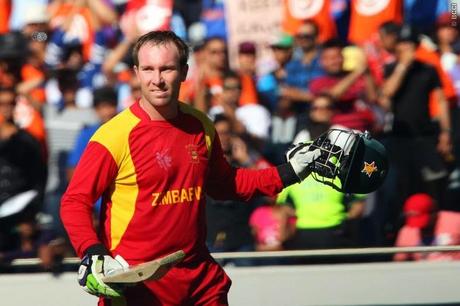
 Photo credit : bcci.tv
Brendan Ross Murray
Taylor has played 23 tests made 1493 runs and in 166 One dayers made 5258 runs
including 8 centuries. In the present
edition, Taylor has made 408 runs, which puts him in third place on
the runs-scorer list, and needs just 10 more to go into second place. The 41st
over of Jadeja was a nightmare for the bowler as Taylor tore him apart for
(1)-4-4-6-4-6; Sir Jadeja will remember him for ever…… but why would he not
play for Zimbabwe again and what is a ‘Kolpak’ player ?? Faf du Plessis was
once a Kolpak player? Andy and Grant Flower too held similar status !
A
player becomes eligible to sign for a county under the Kolpak deal only after
he gives up his right to play for his country. According to rules, a Kolpak
player must not have represented his country in the past 12 months and during
the period of his contract with a county, he will not be eligible to represent
his country. There
are broadly two categories of Kolpak players. Quite a few aged cricketers, who
are out of reckoning when it comes to national selection, turn to playing
domestic cricket in England mainly for financial gains and love for the game.
The other category is a young cricketer, who decides to head in the direction
of an EU nation in hopes of pursing his career. Even players in their prime
have taken the Kolpak path, sometimes to re-establish themselves on the
cricketing scene, sometimes due to disputes with their boards, while for some,
county cricket is a good career option in comparison to national duty.
The
Kolpak ruling is a European Court of Justice ruling handed down on 8 May 2003
in favour of Maroš Kolpak, a Slovak handball player. It
declared that citizens of countries which have signed European Union
Association Agreements have the same right to freedom of work and movement within
the EU as EU citizens. Thus any restrictions placed on their right to work
(such as quotas setting maximum numbers of such foreign players in sports
teams) are deemed illegal under EU law. The legal actions in Germany set a
precedent for professional sports in Europe, which have had a wide-ranging
effect, especially in regard to English county cricket and European
professional rugby.
The Court of
Justice's Bosman ruling in 1995 had declared that, in accordance with the EC
Treaty rules regarding freedom of movement for workers, no resident of the
European Union should be restricted from working in another part of the EU on
the grounds of their nationality. For example, a German football team could not
be prevented from signing a Greek player since both nations are members of the
EU.
Maroš Kolpak was a
Slovak handball player, who was legally resident and working in Germany. The
German Handball Association held that equality of treatment applied only to
citizens of European Union countries (as per the Bosman Ruling) and not to
non-EU citizens. The case was referred by the German higher court to the European
Court of Justice, for a determination on whether the Association Agreement
between Slovakia and the European Union provided equal rights for Slovak
workers who were living and working legally within the EU. The Court ruled in
favour of Kolpak. Thus the Kolpak Ruling
declares that citizens of countries which have applicable Association
Agreements with the EU, and who are lawfully working within an EU country, have
equal rights to work as EU citizens, and cannot have restrictions such as
quotas placed upon them. Such countries include those within the African,
Caribbean and Pacific (ACP) group of states, such as South Africa, Jamaica and
Zimbabwe.
So,
Brendan Taylor is a Kolpak player, ineligible to play for Zimbabwe after such a
fine show ……….. and might sometime show up for England. Strange are the ways of
Photo credit : bcci.tv
Brendan Ross Murray
Taylor has played 23 tests made 1493 runs and in 166 One dayers made 5258 runs
including 8 centuries. In the present
edition, Taylor has made 408 runs, which puts him in third place on
the runs-scorer list, and needs just 10 more to go into second place. The 41st
over of Jadeja was a nightmare for the bowler as Taylor tore him apart for
(1)-4-4-6-4-6; Sir Jadeja will remember him for ever…… but why would he not
play for Zimbabwe again and what is a ‘Kolpak’ player ?? Faf du Plessis was
once a Kolpak player? Andy and Grant Flower too held similar status !
A
player becomes eligible to sign for a county under the Kolpak deal only after
he gives up his right to play for his country. According to rules, a Kolpak
player must not have represented his country in the past 12 months and during
the period of his contract with a county, he will not be eligible to represent
his country. There
are broadly two categories of Kolpak players. Quite a few aged cricketers, who
are out of reckoning when it comes to national selection, turn to playing
domestic cricket in England mainly for financial gains and love for the game.
The other category is a young cricketer, who decides to head in the direction
of an EU nation in hopes of pursing his career. Even players in their prime
have taken the Kolpak path, sometimes to re-establish themselves on the
cricketing scene, sometimes due to disputes with their boards, while for some,
county cricket is a good career option in comparison to national duty.
The
Kolpak ruling is a European Court of Justice ruling handed down on 8 May 2003
in favour of Maroš Kolpak, a Slovak handball player. It
declared that citizens of countries which have signed European Union
Association Agreements have the same right to freedom of work and movement within
the EU as EU citizens. Thus any restrictions placed on their right to work
(such as quotas setting maximum numbers of such foreign players in sports
teams) are deemed illegal under EU law. The legal actions in Germany set a
precedent for professional sports in Europe, which have had a wide-ranging
effect, especially in regard to English county cricket and European
professional rugby.
The Court of
Justice's Bosman ruling in 1995 had declared that, in accordance with the EC
Treaty rules regarding freedom of movement for workers, no resident of the
European Union should be restricted from working in another part of the EU on
the grounds of their nationality. For example, a German football team could not
be prevented from signing a Greek player since both nations are members of the
EU.
Maroš Kolpak was a
Slovak handball player, who was legally resident and working in Germany. The
German Handball Association held that equality of treatment applied only to
citizens of European Union countries (as per the Bosman Ruling) and not to
non-EU citizens. The case was referred by the German higher court to the European
Court of Justice, for a determination on whether the Association Agreement
between Slovakia and the European Union provided equal rights for Slovak
workers who were living and working legally within the EU. The Court ruled in
favour of Kolpak. Thus the Kolpak Ruling
declares that citizens of countries which have applicable Association
Agreements with the EU, and who are lawfully working within an EU country, have
equal rights to work as EU citizens, and cannot have restrictions such as
quotas placed upon them. Such countries include those within the African,
Caribbean and Pacific (ACP) group of states, such as South Africa, Jamaica and
Zimbabwe.
So,
Brendan Taylor is a Kolpak player, ineligible to play for Zimbabwe after such a
fine show ……….. and might sometime show up for England. Strange are the ways of 14th Mar 2015.