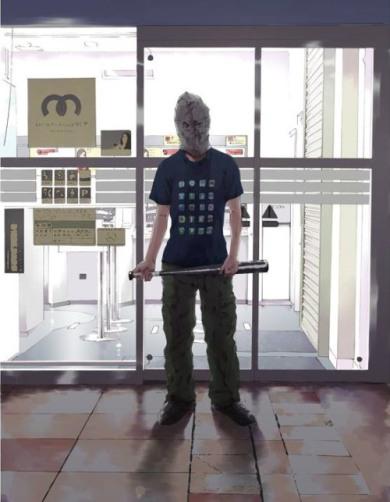
“The level of idiocy of some people in this world surpasses imagination.”
***
Okuda is a long time temp worker at a computer software company in 2008, and after suddenly realizing that he was never going to get a long term, stable position, he eventually got fired for being “fucking useless,” or bringing up the subject of advancing in the company and “questioning” his boss. With no description of his family situation or friends he can rely on for some brief help, he turns to working mediocre and sometimes plain weird jobs where he has to wait at a location and be picked up to do work. No interview or resume needed, just be young and ready to work on whatever’s assigned. During this job, he met four other people with mediocre, or more appropriately, bad situations that has them all doing heavy labor at god knows what time in the morning for god knows how long. Those five bonded during that time.
Then the man known as Slim died.
Slim was one of the few with a bad past. He’d lived in the slums of the Philippines. His mom eventually died of illness, but before she died told him his dad was somewhere in Japan. When going to Japan to look for his dad, he soon learns his dad died because of bad kidneys.
Slim, real name Nelsin Kato-Ricarte, died because he sold one of his kidneys and most likely it was not done at a great hospital. The four others were obviously crushed. And the foreman who hired them on the spot when told of Slim’s death? His exact line:
“…Oh. So he’s dead. Happens all the time. I’ll fill the vacancy tomorrow.”
There are a lot of people in this world, so the foreman’s mentality is not really surprising. For this line of work, there’s no need for sorrow. It’s not like anyone else cares if someone you don’t know and never really knew about their life situation just died because he wasn’t cut out for physical work. It’s a case of finding someone else who can be a replacement because we’re not humans, just workers.
One of the core themes Tetsuya Tsutsui explores in Vol 1 of Prophecy is basic humanity, or how we constantly degrade humans at every step because we don’t “really” know them. This has always been a basic struggle — after all, I know you see homeless people as you walk towards the train station or you’re on the train and you have homeless ask people for money and the most you can do is either ignore or scoff at them. Or, it’s a situation at work where you see someone incapable of doing a job and instead of helping them you make fun of them. In some cases you say it’s justified, but in others, it may not. Whatever the case, an obvious deficiency in Slim and the work required by him leads to his death, and the manager can only say with little emotion to move on and force the four to bury a dead man. He even throws a shovel at Slim for some unconscionable reason, and expects someone to pick it up and bury him somewhere. That sure seems human.
Of course, murdering the foreman, burning the building, and leaving the corpse of the guy they killed is not exactly human either. That’s just what the four did though, which sets the stage at least two, three years later (it’s never specified in the story).
***
“If you don’t like what someone posted, why not just tell them directly?”
Since I like sports, I hear about a lot of sports stories even if I’m not interested in said sport, so excuse me if I tie in something relevant to the quote said by Daiki Okomoto, one of members of the Anti-Cyber Crimes Division (which you can guess is a unit in Prophecy that specializes in internet crime) and clearly a guy not in touch with current trends since he spouted off this quote (and well, he didn’t even know what a flame war was so…). Last year, a professional boxer and former soccer player was being berated on Twitter by some user who’s tweeted negative things at him for months. After the last set of tweets occurred after he lost a bout, instead of blocking him — he joked he didn’t know — he searched up who this guy was, actually went to this user’s area, and challenged the guy to say everything he said to him in his face.
Needless to say, the user did a full 360.
Sometime in May this year, after years of repeated calls and social media jabs regarding himself and his daughter, boxer Deontay Wilder took up the challenge of some white dude in a boxing match.
I think the sad part is the guy really believes he stood a chance against him, and wanted a second chance.
Needless to say though, it’s rare to actually tell someone directly that you don’t like what they posted. These stories in itself are great and also hilarious, but mostly because of its rarity. It’s just not how the internet is wired. For people with normal jobs that frequent social media, they can get away with a bunch of stuff, with a ok amount actually managing to be sociable. For those in Wilder’s profession, or most athletes in a sport that makes a lot of money, or actors, entrepreneurs, etc, they’re a face that the public looks up to, for better or worse. This means that they can be deified, to a small or huge extent. It means they have a responsibility, and they have to roll with whatever punches they get, no matter how awful they might be.
In the case of Daiki’s words, this was said after they were looking over the incidents of Paperboy, or Okuda, and his threats of vigilance towards certain people who either do stupid stuff or cause actual harm and lord their privilege to escape meaningful criticism. The first incident we learn of in Prophecy is what I’ll brazenly assume was a popular food processing company that blamed flawed legislation instead of apologizing for poisoning people’s food; the second involved a guy who deep fried cockroaches; the third involved a sexist guy who tweeted about a sex crime that disparaged the woman (“It’s her fault for being so easy!”). The food processing company ended up having their building burned, the guy frying cockroaches ended up getting humiliated online and in person by a Paperboy, and the third ended up having a vibrator stuck up in his butt, in addition to being stalked since then.
As I read Prophecy, the only connection that came to my mind in terms of taking individual vigilance upon yourself when it’s clear the law doesn’t work and people don’t want to do right is Death Note. I think most of us know what Death Note involves, with Tsutsui’s manga being more of a step up in its target audience (and no fancy powers) than what can be at times juvenile with that manga. Code Breaker also fits the mold as a core group who choose to mete out punishment to those they feel try to escape the law, but this is another one with characters displaying abnormal powers.
Prophecy just has someone who’s decent with computers and has a good weapon to abuse, a chubby guy who left the high life (he had an opportunity to run his family’s engineering firm) for the low life (unstable jobs and connections), a former shut in that was obsessed with eroge (well dating sims, but let’s go with eroge), and a failed musician who hates the Japanese music industry. These are the heroes in this manga.
As you can also guess, they’re also anti-heroes as they try and administer their own brand of justice.
***
It doesn’t take very long for Paperboy’s exploits to spread on the internet. It gets written up on a site, then gets aggregated by a site that gets 2 million views a day, and then the comments come by. It doesn’t matter what it is, as Lt. Erina Yoshino of the Anti-Cyber Crimes Division mentions — if it gets hits, it’s good enough. I can only say this made me think of Polygon, Kotaku, Sankaku–which for many people say are the gold standard of sites only out to get hits, no matter how they do it.
Anyways, the perception of Paperboy in Chapter 3 is that he’s an annoying, awful individual with too much time on his hands, and to be able to do any of the stuff he’s done is sickening. Most people hate him. As always though, you have a few guys who take the other side, and support what Paperboy’s doing. This, as Yoshino of the Anti-Cyber Crimes Division says, is what she says as people who “don’t care a whit about justice or the law.”
You can argue considering the three incidents by the accused described at this point that there’s little justice or law in what’s happened so far. The only problem is you have what amounts to a group of people tired of being treated like subhumans administering their brand of justice…which they’re not authorized to do. They aren’t exactly the best of people, and out of nowhere, they believe they can swing things in a way that’ll get people to listen. To follow. We don’t know if they’ll join in and act as Paperboys yet — I hope not — but the Paperboys are probably counting on that to happen. But whatever the case, the line has been drawn in the sand, they know what they’re doing is wrong, and now it’s a case of what will happen to these four when it’s all said and done?

Zero coverage of Paperboy’s exploits.
Online however? Twitter, Youtube (named “Yourtube” here), Blogs, etc, all has your Paperboy needs.
Not gonna dwell on this long, but remember when the Ferguson/Michael Brown shooting occurred? My only source of information came from Twitter. You turn to CNN, nothing. Fox, nothing. CBS, nothing. Sure it happened in a small town, but when there’s this level of incompetence and there’s protests turning violent, you’d expect there to be coverage picked up by most mainstream places. Nope. Only a day later does it get picked up and eventually get turned into what it did (a circus). You know how you consciously avoid watching certain channels and rely on Twitter and such? Yep, this manga also covers the media and media perception, to a small extent in Vol 1 at least. This is a reminder about how the internet has essentially become the place where we get our information, and as cable TV gets longer in the tooth, there may be a day where the internet will be the source for just about everything. I think we’re still a ways away, but the steps are in place, so it may not take too long.
You can also argue that Paperboy’s only had three incidents up to that point, so why should the media cover something like this when it hasn’t happened at a larger scale? Ultimately, it comes down to media responsibility, and what you believe the media should actually be trying to show to the people.
***
I think, no matter how it goes in the last two volumes, Prophecy is a manga that deserves a look. I do have some issues with it. The art is pretty mediocre, and along with that, the character designs look funny in certain aspects, and aren’t terribly engaging. Certain moments do seem shounen-like despite this being published in a seinen magazine, most notably the reaction when Yoshino shouted out that the second victim had a vibrator shoved up his butt. I guess it would require some semblance of aghast, but I don’t need two grown men spitting out their coffee over this or ladies nearby gossiping about it. The actual crimes seem weak so far — strong enough to set things up and make the volume enjoyable, but there can be more things I believe can be done with the themes presented in Vol 1 — and honestly, it might have been too early to try and establish a character background for Okuda.
But let’s face it: there’s not a lot of manga in the market over here with any meaningful take on social media and its issues, and while I have no clue if this will explore its themes in an interesting and good way, at least at this point, it does it very well. With only two more volumes of this upcoming and with it set up pretty well, I have to keep reading. Who exactly will Paperboy target? How dark well this end? What themes will be explored? Personally, there should be an arc involving someone famous as opposed to someone with little cache. More media criticism. Whatever the case, I’m definitely looking forward to reading more of this work, and if you live online and on social media, you’re probably obligated to check this out.