


Tinian, Northern Mariana Islands (CNN) - It is a discolored concrete slab, molded in tropical humidity. But on this slab, not much larger than the footprint of a beach cabin, the story has changed.
What was once a door is obvious, as are the bases of some interior walls and an opening for a larger garage-style entrance.
I go through the door, inside and through the garage. As I do, my guide puts these few steps in an extraordinary perspective.
"You are following the path of the atomic bomb."
This slab is where the atomic bombs that were dropped on Hiroshima and Nagasaki 75 years ago were assembled. It is the meeting point for the dawn of the atomic era.
Now it is found, largely overlooked, on the Pacific island of Tinian, where the B-29 bombers of the United States Air Force that carried out these atomic strikes on Japan departed.
North Field
Tinian is part of the Northern Mariana Islands, now an American territory in the Pacific. In 2020, it is a sleepy, rustic and tropical paradise of 3000 inhabitants. There are a handful of restaurants, a few small hotels and a single gas station on its 39 square miles (101 square kilometers).
In 1944, Tinian and its sister island of Saipan, eight kilometers north, were the scene of heavy fighting between the United States and Japan.
The United States needed the islands so that its state-of-the-art B-29 bombers could hit Japan, 1,500 miles away. And in the summer of 1944, after three months of fighting that included some of the bloodiest battles in the Pacific, the United States secured the islands and quickly built large air bases for its new bombers.
O
n one morning in January 75 years later, I explore one of these bases, North Field.
At the site of the atomic bomb assembly building, my guide and I get into the rented Toyota Corolla for the next stages of the bomb journey, a short drive to the wells in which they were lowered, and then hoisted into the belly of the bombers who would carry them to their targets.
Tall grasses and brush have grown around North Field over the decades. They get closer to the Toyota, even scratching its sides at times.
But in 1945, it was an open plain filled with acres and acres of workshops and tents and planes and men, supporting what, at one point during World War II, was the busiest airport in the world.
While what surrounds us on this tropical morning has changed, what lies beneath is the same asphalt laid by the US Navy Seabees, or construction battalions, 75 years ago.
The longevity of this construction is remarkable in itself. Think of the roads and highways you drive on, how potholes develop and surfaces collapse in your short-term memory. The sidewalk below us has not been touched for more than seven decades.
The path we take leads to a clearing the size of a supermarket parking lot. Two glass structures, perhaps four or five feet high, are visible at separate corners on the same side of the small cushion.
My guide is Don Farrell, originally from California who moved to the Pacific Islands in the 1970s. Locals recognize him as Tinian's chief historian, and he detailed the story of what happened here in 1945 in his book, "Tinian and the bomb".
He led efforts to dig and preserve these bomb wells over ten years ago and describes how the atomic bombs were loaded in the B-29s.
Think about when you have your car overhauled and a hydraulic lift places it above your head so that mechanics can work underneath. This is how the bombs entered the belly of the planes, he says.
I move the rental car back to the edge of the bomb pit.
"Have you already saved a trailer in your driveway?" Farrell asks. "Imagine doing this with a B-29."
With that, we are about to make the short trip to the end of the capable runway on North Field, the very runway of the B-29, named Enola Gay, took off at 2:45 am on August 6, 1945.
The journey takes a few minutes by car. It would have been much longer for the B-29 and its payload of 9,700 pounds (4,400 kilograms).
I stop the car and align it in the center of Runway Able, trying to recreate the movements of the pilot of Enola Gay, Colonel Paul Tibbets, 75 years ago.
My co-pilot, Farrell, nods and hits the accelerator. I ride on the same track where history was written 75 years ago, and when the tarmac passes below me, I get goosebumps.
It's about a two minute drive to the track. Farrell provides imagery of what the Tibbets would have seen - the tents, the troops, the dozen B-29s.
Although it was two quick minutes for me, it was far from the case for the men aboard Enola Gay, says Farrell.
They were doing something that had never been done and that they believed would accelerate the end of the Second World War and certainly change history.
"For the men of Enola Gay, it was the longest two minutes of their lives," said Farrell.
Enola gay
You can see this plane now in the suburbs of Washington, DC.
Enola Gay is one of the centerpieces of the Steven F. Udvar-Hazy Center, the annex of the Smithsonian Air and Space Museum in Chantilly, Virginia.
It sits in the middle of the museum, surrounded by dozens of planes of all ages, from the origins of the Space Shuttle Discovery flight.
As I walk towards him, seeing him for the first time during a visit in November 2019, I feel a shiver.
"It is a very dark artifact," says Jeremy Kinney, museum curator.
For one, it represents the best of the U.S. war effort during World War II, a technological leap, designed, engineered, built and deployed in about five years.
On the other, he carried the first atomic weapon ever used, one that killed 70,000 people in the first moments after his fall and tens of thousands of others from his aftermath.
"The Enola Gay has been controversial, for the Smithsonian and for the country," says Kinney.
Kinney and the museum offer some interesting facts about Enola Gay:
The B-29 was designed to be an intercontinental bomber, which could fly from the continental United States to Europe in the event that Great Britain fell against Nazi Germany;
It was one of 300,000 aircraft produced by the United States during the Second World War and one of 15 B-29s specifically designed to transport atomic bombs;
Pilot Tibbets chose this plane while it was still on the assembly line in Omaha, Nebraska, to be used for atomic bomb missions, but it got its name - after its mother - only a short time before leaving for its historic mission.
What Visitors Won't Get at the Smithsonian Enola Gay Exhibition is a complete story of the Hiroshima bombing. There are no Hiroshima artifacts, no discussions about the victims of the bombs or whether the use of atomic weapons was necessary.
The plan to include such content in the Enola Gay exhibit was abandoned in 1995, when, under pressure from American veteran groups, the secretary of the Smithsonian I. Michael Heyman said that he would not include analysis, but would only commemorate and honor the sacrifice of the American war. Veterans.
But standing in front of the silver-skinned bomber, Kinney says he's still sending an important message.
"It gives us a lot of break when it comes to the power of technology," he says.
"We wanted to broadcast this so that people can see it, people can bring their stories, their perspectives, to look at this decisive turning point in human history - the atomic age, the end of World War II - but also what highest development of aeronautical engineering in the first half of the 20th century. "
This is the message that Toshihide Naganuma, a 50-year-old visitor from the Smithsonian of Osaka, Japan, carried with him.
"I was amazed at the plane," said Naganuma. "It shows the technical capabilities and the economic strength to make something like this."
As for his feelings as Japanese, Naganuma is not emotional.
"I was born after the war, so for me it's only part of the story," he says.
Hiroshima
On the other side of the world, where the atomic bomb killed 70,000 people with its initial explosion and left tens of thousands more to die slowly from burns or radiation-related illnesses, this story can still be believed and its stories tell us hold dear.
Inside the Hiroshima Peace Memorial Museum, which is located near Ground Zero in the Japanese city, a permanent exhibit details some of the schoolchildren who were killed by the bomb.
The room is dark and silent and solemn. Behind display cases, portraits, clothes, bikes, dolls and drawings of the dead are displayed with their stories.
They talk about children who want to be able to sacrifice their lives for their mothers' lives, and about mothers who think that knocking on the front door is the child she hasn't seen in years.
It's hard to stifle tears.
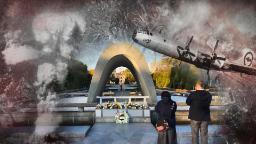
A few steps away is the dome, the emblematic remains of the industrial promotion hall of Hiroshima Prefecture, now known as the Hiroshima Peace Memorial.
It was near a T-bridge which was the aim of the Enola Gay crew. The atomic bomb nicknamed "Little Boy" exploded 2000 feet above it.
Along the sidewalk that surrounds it and along the bank of the Motoyasu River, Kosei Mito parked his bike and displayed his passion - documents to detail what happened here and hopefully make sure let it happen nowhere.
Mito is an in utero survivor of the atomic bomb; his mother was four months pregnant with him on August 6, 1945.
Now a retired teacher, he says he has been coming to the dome almost daily for 13 years, cycling 10 kilometers from his home.
The bike is loaded with documentation of the Hiroshima bombing and its aftermath. It's in Japanese, English and Chinese but it will give you other languages if you want them.
"It's my open class. I can tell everyone what they want to know," says Mito.
He will examine the laminated pages of his loose-leaf binders with any interested visitor. He will cite studies and documents from both sides of the Pacific to bring together his unique - and wise - account of Hiroshima, with one goal in mind: "Without knowing the historical facts, we can repeat the same mistakes."
Whether it is busy or not, there are several other residents who will give you a free tour of the park with all the historical details.
But Mito's passion and experience are worth the wait or the second day.
The 74-year-old man turns to a page in one of his binders with a great quote that Pope John Paul II made during a visit to Hiroshima in 1981, which is inscribed on a memorial at the interior of the Hiroshima Peace Museum.
"To remember the past is to commit to the future."
Mito says that these are words by which he lives.
"We have no responsibility for what has happened in the past, but we have a responsibility for the future," he said.
About fifty yards from where Mito tells his story, a westerner sits on a bench, smokes a cigarette and watches the exposed superstructure of the dome.
He wears a T-shirt from Baylor University in Texas, revealing him to be an American, but Raymond Godzisz says he is actually from Winston-Salem, North Carolina.
It was his first visit to Japan, and before coming, he had no idea what he was seeing now.
Asked what it means to him, he struggles to find words.
"As an American, our country did that, but I had nothing to do with it so it's like ...
"I'm just glad they (the Japanese) don't refuse us," he said.
It is clear that this experience will remain with him for a long time.
"I just can't stop looking at it," he says.
If you are going to:
Tinian is accessible via small planes of Star Marianas Air from Saipan International Airport, which is served by international airlines from the United States, Japan, South Korea and China. To get to North Field, rent a car for the 20-minute drive from Tinian Airport.
The Steven F. Udvar-Hazy Center - temporarily closed due to the Covid-19 epidemic - is normally open daily from 10 a.m. to 5:30 p.m. near Dulles International Airport in Virginia. Admission is free, but parking is $ 15 before 4 p.m.
The Hiroshima Peace Memorial Museum, also temporarily closed, is regularly open every day (except December 30 and 31) from 8:30 a.m., the closing hours vary according to the season. Entrance is 200 yen.






