RV travel has a funny way of reminding you who’s really in charge. You plan the route. The rig plans the surprises.
A tripped breaker at dinner. A propane hiccup just as the furnace kicks on. A pan fire that jumps higher than expected because the rig isn’t level. None of these feels dramatic at first. They feel manageable. Until they aren’t.
An RV is a compact, moving system packed with heat, fuel, wiring, and vibration. There’s less space, fewer exits, and very little margin for error. Small problems don’t stay small for long. What would be an inconvenience at home can turn serious fast on the road.
That’s why safety gear isn’t optional. It’s foundational. It’s what gives you time to think instead of react. It turns panic into a plan.
This guide covers essential RV safety equipment, with a strong focus on the RV fire extinguisher, as well as fire blankets, first-aid kits, emergency kits, and gas and smoke alarms. Every item here is selected for real RV use in the United States, from brands with a track record of showing up when things go sideways.
You may never need most of this gear.
But if you do, you’ll want it within arm’s reach.
Why Safety Gear Is Different in Recreational Vehicles
An RV isn’t a house. It’s closer to a boat on wheels. Everything is compact, interconnected, and constantly in motion.
While you’re driving, vibration works on every system. Screws loosen. Wires rub against sharp edges. Fittings flex. Even when parked, temperature swings cause materials to expand and contract. Over time, those small stresses add up.
Heat builds faster, too. RV interiors warm quickly, especially in summer or when appliances run simultaneously. There’s less air volume to absorb heat and smoke, which means fires burn more aggressively and fumes spread faster than in a house.
Escape routes are limited. Most RVs have one main door and maybe an emergency window. If a fire starts near the kitchen or entry, your options shrink fast. That reality changes how quickly you need to detect problems and respond.
Electrical wiring runs through tight channels behind thin walls. Propane lines feed stoves, furnaces, water heaters, and refrigerators, often all from the same system. Campground power can be unpredictable, with voltage drops, loose pedestals, and overloaded circuits. These are risk points you simply don’t face at home.
Safety gear exists to offset those constraints. It doesn’t eliminate risk, and it doesn’t make you invincible. What it does is buy time. Time to notice trouble early. Time to act before conditions escalate. Time to turn a dangerous moment into a controlled one.
RV Fire Extinguishers
If there’s one section that matters most, it’s this one.
An RV fire extinguisher is the first and sometimes only tool you’ll have if a fire starts inside your rig.
What Makes RV Fires More Dangerous
- Fires spread faster in confined spaces
- Propane-fed flames intensify quickly
- Electrical fires often start hidden
- Exits are limited
That’s why water-based extinguishers are useless here. RVs require ABC-rated dry chemical extinguishers.
What to Look For in an RV Fire Extinguisher
Ignore fancy marketing. Focus on function.
- ABC rating – handles grease, electrical, and solid fires
- Metal valve – plastic weakens with heat and age
- Rechargeable canister – cheaper long-term
- Pressure gauge – quick visual check
- Mounting bracket – rolling extinguishers help no one
Size matters, too. Tiny units discharge fast. Bigger units are harder to handle. Balance is key.
Best Overall RV Fire Extinguisher
Kidde FA110 Multi-Purpose Fire Extinguisher

Price: ~$57
This is a workhorse extinguisher. No drama. No gimmicks.
Features
- 1A:10B: C rating
- Metal valve assembly
- Extinguisher UL rated BC listed
- Wall mount included
Pros
- Strong discharge
- Long shelf life
- Easy to service
Cons
- A single unit isn’t enough for most rigs
Best For
Travel trailers, fifth wheels, and Class C motorhomes.
Best Compact RV Fire Extinguisher
First Alert HOME1
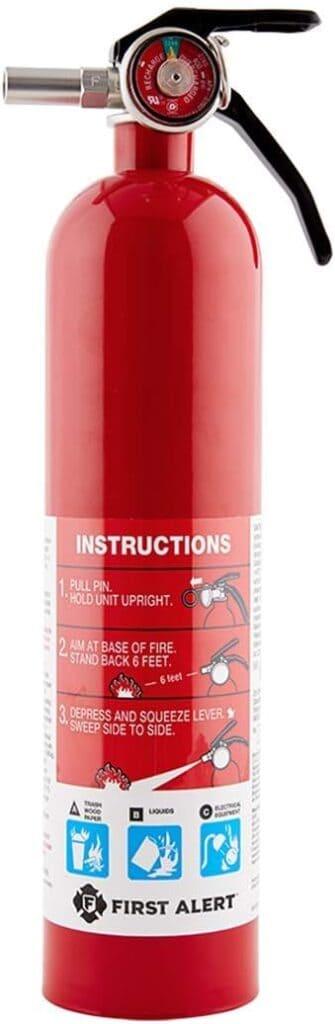
Price: ~$25
Smaller, lighter, and easier to tuck into tight spaces.
Features
- ABC-rated
- Lightweight body
Pros
- Affordable
- Easy to grab quickly
Cons
- Plastic valve
- Shorter discharge time
Best For
Secondary locations or smaller campers.
How Many Fire Extinguishers Does an RV Need?
One is rarely enough.
Fires don’t start where it’s convenient. They begin where heat, power, or fuel meet—and that isn’t always where your single extinguisher is mounted. Distance and obstacles matter when seconds count.
- Small campers: one extinguisher is the bare minimum
- Mid-size RVs: two extinguishers provide real coverage
- Large motorhomes: three is the smart move
Placement matters just as much as quantity. Mount extinguishers:
- Near the kitchen, where most RV fires begin
- Near the bedroom, where nighttime fires are most dangerous
- Near an exit, so you can fight flames while backing out
You should be able to grab an extinguisher while moving toward safety, not walking deeper into the rig. If reaching it means stepping closer to smoke or heat, it’s mounted in the wrong place.
Common Fire Extinguisher Mistakes
Most RV fire extinguisher failures aren’t equipment failures. They’re setup and maintenance mistakes.
Buying non-ABC models is the biggest one. Water-only or specialty extinguishers may work in houses, but they’re useless—or dangerous—around electrical and propane-fed fires.
Mounting extinguishers too high or too low is another issue. If it takes stretching, kneeling, or fumbling to reach it, you’ve already lost precious seconds. It should be at arm’s length and accessible in one motion.
Pressure checks get forgotten, especially on rigs that sit between trips. A flat gauge means a dead extinguisher. Check it monthly. It takes two seconds.
Expired units are more common than people think. Chemicals settle. Seals degrade. An old extinguisher might discharge weakly or not at all.
The final mistake is assuming small fires stay small. They don’t. Flames grow faster in an RV than almost anywhere else. Hesitation is costly.
Fire doesn’t offer practice rounds or second chances.
Fire Extinguisher Safety: What Every RVer Needs to Know
Fire Blankets
Fire blankets are quiet problem-solvers. They don’t make noise. They don’t draw attention. But when a flame pops up where it shouldn’t, they act fast.
They don’t spray. They don’t cloud the air. They don’t leave powder everywhere that you’ll be cleaning for days. They simply cut off the oxygen supply and stop the flames at the source.
That simplicity matters in an RV. Tight spaces make extinguishers harder to aim, and chemical residue can spread through the entire rig. A fire blanket lets you react quickly and decisively, especially during small kitchen flare-ups or clothing fires, without turning a bad moment into a bigger mess.
Think of a fire blanket as your first response tool. It’s there for the fast, contained problems—before they have a chance to grow.
What a Fire Blanket Is Used For
- Grease fires on stovetops
- Clothing fires
- Small appliance flare-ups
They’re especially helpful when panic sets in, and spraying feels overwhelming.
Best Fire Blanket for RV Use
Prepared Hero Fire Blanket

Price: ~$30
Features
- Fiberglass weave
- Wall-mounted pouch
- No expiration date
Pros
- Zero mess
- Simple to use
- Safe near kids and pets
Cons
- Not suitable for large fires
Fire Blanket vs Fire Extinguisher
Fire blankets handle fast, contained problems. Fire extinguishers handle escalation. Together, they give you control.
First Aid Kits for RV Travel
Injuries don’t need to be dramatic to ruin a trip.
A burned hand makes cooking miserable. A twisted ankle limits movement. Small cuts get infected fast outdoors.
Why RV First Aid Needs Are Different
You’re often far from clinics. Cell service is spotty. Help isn’t instant.
Your kit needs to bridge that gap.
What an RV First Aid Kit Should Include
- Trauma pads
- Burn gel
- Antiseptics
- Elastic bandages
- Gloves
- Tweezers
- Scissors
- Medications
Anything less is a convenience kit.
Best Overall RV First Aid Kit
Adventure Medical Kits Mountain Series Hiker

Price: ~$45
Pros
- Excellent organization
- Durable packaging
Cons
- Refills sold separately
Best Value RV First Aid Kit
Swiss Safe 2-in-1 First Aid Kit

Price: ~$40
Pros
- Large supply count
- Compact storage
Cons
- Some items are entry-level quality
Where to Store a First Aid Kit
Near the door. Not buried. Not locked. Speed matters.
In an RV, injuries don’t wait for you to dig through cabinets. A cut hand, a burn, or a fall needs immediate attention. If you have to move gear, open multiple compartments, or remember which bin it’s in, the kit is stored wrong.
The best spot is somewhere visible and easy to grab on the way out or on the way back in. Many RVers choose a cabinet by the entry, a bench seat, or a low drawer that opens fully.
Everyone traveling with you should know where it is. In an emergency, clarity beats organization.
RV Alarms and Detectors
Alarms exist to wake you up before danger becomes irreversible. That’s their entire job. They don’t prevent problems. They give you a warning while there’s still time to act.
In an RV, that warning matters more than it does at home. Air space is limited, so smoke and gas build up quickly. You’re often asleep a few feet from the source, with appliances running and vents closed. Without alarms, dangerous conditions can develop silently.
Ignoring alarms is gambling. Silencing chirps, removing batteries, or assuming false alerts are harmless trains you to miss the real one. When an alarm sounds, it deserves attention every time.
Working detectors turn unseen threats into noise you can’t ignore. And that noise can save lives.
Carbon Monoxide Alarms
Carbon monoxide has no smell. No warning.
Safe-T-Alert 30 Series

Price: ~$70
Designed specifically for RV air volumes.
LP Gas Alarms
Propane sinks. Leaks collect low. One spark is enough.
MTI Industries Safe-T-Alert 20 Series

Price: ~$80
Smoke Alarms
Yes, RVs still need them.
First Alert BRK 9120B

Price: ~$95
Alarm Placement and Maintenance
- Test monthly
- Replace at end-of-life (every 5 years minimum)
- Don’t disable after false alarms
False alarms are annoying. Silent alarms are deadly.
RV Emergency Kits
Breakdowns don’t care where you are.
They happen on busy interstates, empty desert roads, and muddy campground entrances.
When something fails, help isn’t always close at hand. Cell service drops. The weather turns. Traffic flies past faster than it should. That’s when an RV emergency kit earns its space.
Emergency kits don’t fix mechanical problems. They buy time. They keep you visible, warm, and safer while you figure out the next move. Reflective gear keeps passing drivers aware. Jumper cables get you rolling again. Warning triangles give other vehicles room to react.
A good kit turns a stressful stop into a controlled pause. You’re not scrambling. You’re not guessing. You know exactly where your gear is and what it’s for.
That peace of mind matters just as much as the tools themselves.
What Belongs in an RV Emergency Kit
- Jumper cables
- Warning triangles or flares
- Reflective vest
- Basic tools
- Gloves
Best RV Emergency Kit
Roadside Rescue Deluxe Emergency Kit

Price: ~$84
Solid coverage for most roadside issues.
What to Add Based on How You Travel
- Desert travel: extra water
- Cold climates: blankets
- Long drives: battery packs
Match the kit to reality, not optimism.
Where to Store Safety Gear in an RV
- Fire extinguishers near exits
- Fire blankets in the kitchen
- First aid kits within reach
- Alarms properly mounted
- Emergency kits accessible
If stress makes you forget where it is, it’s stored incorrectly.
FAQs
What type of fire extinguisher is needed for an RV?
A Class B and C fire extinguisher is needed for an RV.
What is the best fire extinguisher for a motorhome?
The best fire extinguisher for a motorhome is a Class B and Class C-rated extinguisher, typically a 2.5 to 5-pound ABC fire extinguisher, suitable for flammable liquids and electrical fires.
How often should I replace my RV fire extinguisher?
Replace your RV fire extinguisher every 5 to 12 years, depending on the manufacturer’s instructions, and ensure to check the pressure gauge monthly.
.
Final Thoughts
Safety gear doesn’t make trips exciting. It never shows up in photos. It never improves your view. And it’s easy to push to the bottom of the shopping list. But it’s the difference between a bad moment and a ruined trip.
An RV is a tight space filled with heat, fuel, electricity, and motion. Small issues don’t stay small for long. When something breaks, leaks, or sparks, your response window is short. That’s where preparation pays off.
A dependable RV fire extinguisher gives you the power to stop a fire before it blocks an exit. Working smoke, carbon monoxide, and LP gas alarms give you warnings while there’s still time to react. A real first-aid kit prevents minor injuries from becoming trip-ending problems. A stocked emergency kit buys comfort and control when plans fall apart on the side of the road.
None of this gear is about fear. It’s about confidence. You don’t buy safety equipment hoping to use it. You buy it so stress doesn’t run the show when something goes wrong. You buy it so decisions stay calm, movements stay deliberate, and small problems remain manageable.
Check your gear. Replace what’s outdated. Mount what’s loose. Then get back to enjoying the trip—knowing you’re ready if the road throws a curveball.