(This article is the last of a six-post reality-check. Concepts and examples are drawn from “Silent Earth: Adaptations for Life in a Devastated Biosphere.”)
Across this series, we have journeyed from the stark physical reality of a wounded planet to the deep, inner landscape of human grief. We have explored the rise of a new geological force in our Technosphere, the radical rethinking of our legal systems through Rights of Nature, the urgent mission to preserve our knowledge, and the profound sorrow of solastalgia.
This journey from the external world to the internal may seem like a shift in focus, but it reveals the fundamental truth of the Anthropocene: the crisis of the biosphere is inseparable from the crisis of our own consciousness. The crucial question is no longer just what technology we can invent, but what kind of beings we choose to become. Can we, armed with knowledge of our own minds, do a better job?
The evidence presented in Silent Earth suggests the path is difficult. Our species is hobbled by cognitive biases that were once adaptive but are now perilous. We discount the future, we are overly optimistic about risk, and we struggle to grasp the slow, cascading nature of complex system collapse (Frederick et al. 2002). These are the mental roadblocks that have led us to this precipice.
Yet, our cognitive toolkit also contains the seeds of a solution. We are, to our knowledge, the only species on this planet capable of understanding its own cognitive flaws. We are the only species that can study its own history, anticipate distant futures, and consciously choose to evolve its culture.
This is the final and most essential adaptation. It is a cognitive adaptation.
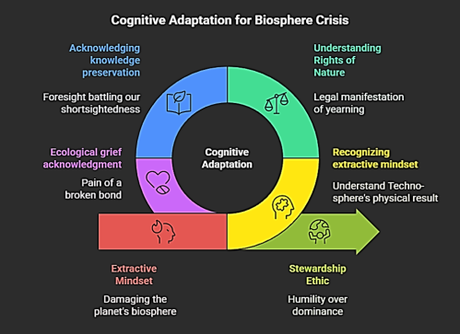
It means recognizing that our sprawling Technosphere is the physical result of an extractive mindset. It means understanding that the call for Rights of Nature is a legal manifestation of our yearning for a more just relationship. It means acknowledging that our mission to preserve knowledge is our foresight battling our shortsightedness, and our ecological grief is the pain of a bond that has been broken.
To do a better job is to use this self-knowledge to consciously steer our cultural evolution. It is to build governance systems that account for our cognitive biases, to foster economic models that value long-term stability over short-term gain, and to cultivate an ethic of stewardship rooted not in dominance, but in humility.
As the great conservationist Aldo Leopold urged, we must make the journey from “conqueror of the land-community to plain member and citizen of it” (Leopold 1949). In a deteriorating biosphere, this is no longer just a poetic ideal. It is the most pragmatic and necessary survival strategy we have left. The ultimate test of human intelligence will be whether we can learn to live wisely on the only home we have ever known.
References
Albrecht, G., et al. 2007. Solastalgia: the distress caused by environmental change. Australasian Psychiatry 15(sup1): S95-S98.
Brand, S. 2018. The manual for civilization. Long Now Foundation Press, San Francisco, 324 p.
Cunsolo, A., and Ellis, N. R. 2018. Ecological grief as a mental health response to climate change-related loss. Nature Climate Change 8(4): 275-281.
Dartnell, L. 2016. The knowledge: How to rebuild civilization in the aftermath of a cataclysm. Penguin Press, New York, 352 p.
Frederick, S., Loewenstein, G., and O’Donoghue, T. 2002. Time discounting and time preference: A critical review. Journal of Economic Literature 40(2): 351-401.
Haff, P. 2014. Technology as a geological phenomenon: implications for human well-being.
Geological Society, London, Special Publications 395(1): 301-309.
Hutchison, A. 2019. The Whanganui River as a legal person. Alternative Law Journal 44(1): 16-20.
Kauffman, C. M., and Martin, P. L. 2017. Can rights of nature make development more sustainable? Why some Ecuadorian lawsuits succeed and others fail. World Development 92: 130-142.
Leopold, A. 1949. A Sand County Almanac. Oxford University Press, New York, 226 p.
Zalasiewicz, J., et al. 2017. The technosphere: its composition, structure, and dynamics. The Anthropocene Review 4(1): 9-28.