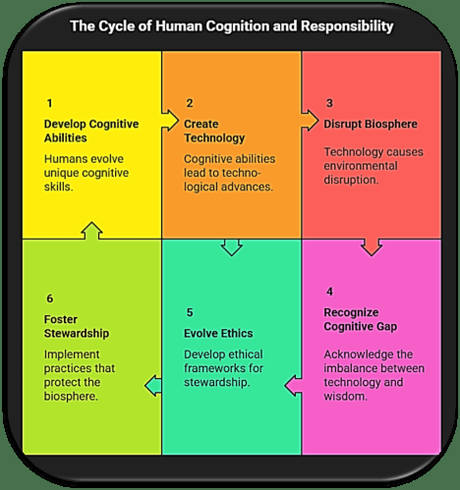
Cognition is everywhere in all creatures. But what about us? Human cognition is an extraordinary elaboration of the capacities found throughout the biosphere. Our ability for symbolic language and cultural evolution has allowed us to accumulate and transmit knowledge across generations. This has transformed our species from one among many into a planetary force that is reshaping Earth systems (Henrich 2016; Steffen et al. 2011).
This unique cognitive power, however, presents a paradox.
- The same intelligence that allows us to understand the intricate workings of the biosphere has also given us the technology to disrupt it (Steffen et al. 2015).
- We suffer from a cognitive gap between our technological capacity and our ecological wisdom. We are brilliant at solving immediate, short-term problems but our cognitive biases make it difficult to address slow-moving, long-term crises like climate change. Biases like temporal discounting (valuing the present far more than the future) might have been essential during our early evolution, but they are now proving to be a critical flaw in our ability to act sustainably (Wagner 2010; van der Leeuw 2020).
If we are not the sole possessors of mind, but merely participants in a broader cognitive community, do we have any responsibility to the other thinking beings?
Acknowledging this shared cognitive heritage is a crucial step. It moves us away from a framework of human domination and toward one of stewardship and reciprocity (Leopold 1949). Indigenous knowledge systems have long embodied this perspective. Many of them emphasize interdependence and respect for all living things (Kimmerer 2013). The challenge for humanity is to evolve our culture and our ethics to match the power of our intellect. We need to learn to use our unique cognitive gifts to ensure the long-term viability of our extraordinary, thinking planet (Bai et al. 2016).
References
Bai, X., et al. 2016. Plausible and desirable futures in the Anthropocene: A new research agenda. Global Environmental Change 39: 351-362.
Henrich, J. 2016. The secret of our success: How culture is driving human evolution, domesticating our species, and making us smarter. Princeton University Press, Princeton, 447 p.
Kimmerer, R. W. 2013. Braiding sweetgrass: Indigenous wisdom, scientific knowledge and the teachings of plants. Milkweed Editions, Minneapolis, 408 p.
Leopold, A. 1949. A Sand County Almanac. Oxford University Press, New York, 226 p.
Steffen, W., et al. 2011. The Anthropocene: conceptual and historical perspectives. Philosophical Transactions of the Royal Society A 369(1938): 842-867.
Steffen, W., et al. 2015. The trajectory of the Anthropocene: The Great Acceleration. The Anthropocene Review 2(1): 81-98.
van der Leeuw, S. 2020. The archeology of innovation: The embodiment of mind. Oxford University Press, Oxford, 368 p.
Wagner, G. 2010. But will the planet notice? How smart economics can save the world. Hill and Wang, New York, 256 p.