(This article is part of a six-post reality-check. Concepts and examples are drawn from “Silent Earth: Adaptations for Life in a Devastated Biosphere.”)
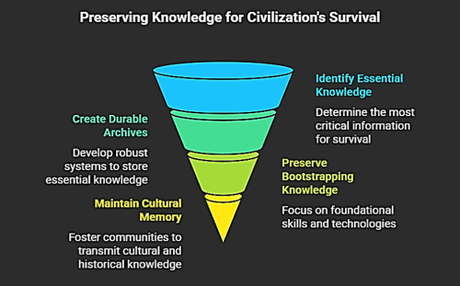
In times of crisis, we focus on saving lives and priceless artifacts. But what about the most vital asset for the long-term survival of our civilization: our accumulated knowledge? As the biosphere degrades and the risk of social disruption grows, the mission to preserve the blueprint of our knowledge becomes a critical imperative.
Our current knowledge systems are fragile. Digital archives are vulnerable to energy loss, hardware degradation, and format obsolescence. At the same time, physical libraries are threatened by environmental disasters (Morrow 2020). This has spurred innovative projects like The Long Now Foundation’s Manual for Civilization, which seeks to create a durable, multi-format library of essential information (Brand 2018).
But it’s not enough to save data. We must preserve what author Lewis Dartnell calls “bootstrapping knowledge.” This is the foundational instructions needed to rebuild basic technologies and access more complex information (Dartnell 2016). Without the ability to make a simple motor or generate electricity, a digital library of all human knowledge would be a useless artifact.
Also important is the preservation of cultural and historical memory, which provides the social cohesion necessary to navigate collapse and recovery. This requires a focus on living knowledge communities and practical skills transmitted through apprenticeship (Marchand 2016). This will be difficult, but safeguarding this blueprint is an essential investment in the potential for a future rebirth.
References
Brand, S. 2018. The manual for civilization. Long Now Foundation Press, San Francisco, 324 p.
Dartnell, L. 2016. The knowledge: How to rebuild civilization in the aftermath of a cataclysm. Penguin Press, New York, 352 p.
Marchand, T. H. J. 2016. Craftwork as problem solving: Ethnographic studies of design and making. Routledge, London, 286 p.
Morrow, J. 2020. Knowledge persistence in unstable times. Library Quarterly 90(2): 154-173.