(This article is part of a six-post reality-check. Concepts and examples are drawn from “Silent Earth: Adaptations for Life in a Devastated Biosphere.”)
When a forest is cleared or a river is polluted, who speaks for them? For centuries, our legal systems have treated nature as property—a resource to be owned, used, and exploited. But what if nature had rights of its own?
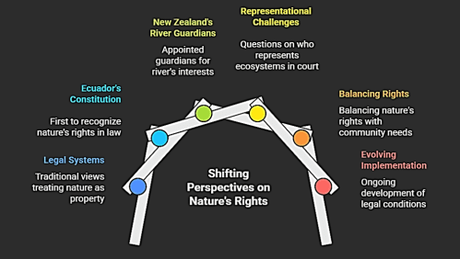
This is not a mere metaphor. In a groundbreaking move, Ecuador’s 2008 constitution enshrined the Rights of Nature, recognizing that nature has the “right to exist, persist, maintain and regenerate its vital cycles” (Kauffman and Martin 2017). Following this, New Zealand granted legal personhood to the Whanganui River in 2017, and appointed guardians to act on its behalf and protect its interests as a living, integrated whole (Hutchison 2019).
This shift from nature as “property” to nature as a “rights-bearing entity” raises complex questions. Who has the standing to represent an ecosystem in court? How do we balance the rights of a river against the rights of a community that depends on it? Implementing these legal conditions is still evolving, but they represent a fundamental rethinking of environmental protection.
By recognizing the intrinsic value and legal standing of the natural world, we open up entirely new avenues for its defense. This approach invites us to move beyond our role as masters of the Earth and toward a more just relationship as members of a wider ecological community. Related Resources
References
Hutchison, A. 2019. The Whanganui River as a legal person. Alternative Law Journal 44(1): 16-20.
Kauffman, C. M., and Martin, P. L. 2017. Can rights of nature make development more sustainable? Why some Ecuadorian lawsuits succeed and others fail. World Development 92: 130-142.