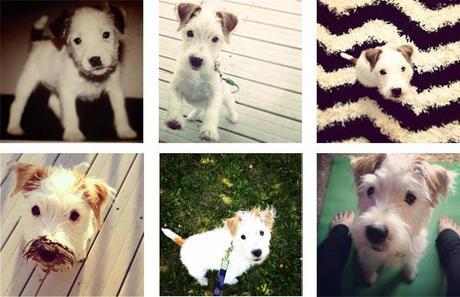
It’s hard to believe, but yesterday was Walter’s 6 month birthday! We’ve had him since January and it’s hard to believe how much our little guy has changed over the past four months. I’ve been asked for puppy advice, and while I’m far from an expert, I feel like we did a pretty good job. Walter had only a handful of accidents in the house, and was flawlessly potty trained within a month. He now sits, lays, stays (almost too well) and started “Shaking hands” last week (by far my favorite trick). So, for what it’s worth, here are the things that worked for us:
1. Think it through. Holy sh*t seriously. Think it through. I’m completely boggled by how people have & train puppies if they are gone for 8+ hours a day. Puppies need attention and small puppies need to go outside every few hours (or more!). Don’t get a puppy unless you or your partner are able to go home during the day (or are willing to pay for daycare). Obviously, people do it, just make sure that the time is right for you.
2. Invest in food. Don’t get a dog thinking that you’re only going to spend $10 a month on dog food. Don’t pay less than $2.00 per pound (closer to $3.00 per pound is the good stuff) pay attention to the labels, learn what ingredients are good + bad. And unless you want to deal with diarrhea, don’t switch your dogs food abruptly (mix it 50/50 with his old food and slowly introduce a new formula).
3. Puppies are predictable. When a puppy eats, it needs to poop immediately. This makes potty training pretty easy. Feed the puppy only twice a day and be consistent about the time. We fed Walter at 6:30 am and 4:30 pm every day for the first two months. In the morning, take the puppy outside immediately (the puppy will likely pee), then feed them, then go outside again (the puppy will likely poop). In the evening do the same. It’s like clockwork and is such an easy way to get your little one to understand where they should go.
4. Accidents happen….but they’re always your fault. When not being closely supervised your puppy should be in a small kennel (big enough for them to stretch out, but not big enough for them to designate 1/2 of it as their “toilet”). Take the puppy outside whenever it wakes up from a nap or whenever it finishes playing. Another good indicator is that if you are playing with the puppy and it suddenly loses interest in you, the toy, or the activity, take them outside. If you find a “mess” after the fact—clean it up and move on. But if you catch the puppy in the act, clap your hands to startle them and firmly say “no”. Always clean the mess up well (stand on the spot with paper towels until they turn up dry) and then go to town with some deodorizer. You don’t want the puppy to feel that his territory is “marked”.
5. Throw away the puppy pads. For the love of God. I still don’t understand how people think that giving your dog a giant maxi pad to pee on teaches them that they should go on grass. Use these and you’ll end up with a very confused dog who will likely pee on anything white and fluffy for the rest of their life (you know, carpet, furniture, your $400 down comforter). A lazy owner helps no one.
6. If you wouldn’t eat it, don’t make your dog. There are several dog treats that I have bought Walter, smelled, and thrown away. Just like there’s junk food for humans, there’s junk food for dogs. Find treats that are healthy—we tend to lean towards the natural or homemade variety.
7. Buy toys and activities! A squeaky ball entertains a dog, but only for so long, especially without your interaction. There are lots of different interactive toys that can help keep your buddy entertained. Some of our favorites are the Hide-A-Squirrel, the water bottle crunchers, the tug-a-jug, and the kong (filled with natural peanut butter or something else besides the kong EZ-Chez stuff, gross).
8. Barking. Walter loves to spend his days snoozing on the portion of my desk that goes in front of the window. When he was a puppy he would whine & bark as neighborhood dogs walked by. I’d counter this by petting him and soothingly saying “That’s your buddy, he’s out on a walk, he’s nice” etc. This helped Walter learn that people or other dogs (or the garbage truck, mail man, UPS guy bringing me my new shoes <—happens a lot) were not intruders and were not worth barking at. He also learned that if he sat there and didn’t bark I would pet him. Now he rarely makes a peep. The mistake most owners make is punishing the dog for barking, or picking the dog up/removing the dog from the situation. Both of these just make them more anxious and will induce the barking. All of this also applies to the door bell & guests.
9. Schedule. Just like kids, dogs appreciate having a daily schedule. Be consistent about what times they are fed and when they do certain activities. It doesn’t have to be complex—Walter’s is something like this: 6:30 am Breakfast, 8:30 am Chew Stick, 11:00 Walk to the Park, 1:30 pm Snack, 3:00 pm Activity Toy, 5:00 pm Dinner. Within a few months of doing that he started to know the routine. I can’t say enough about what this will do for training, having a well behaved dog, a dog with a great personality and a great dog/owner relationship.
10. Price Check. In honor of Walter’s 6 month birthday I got to start researching neutering. We take Walter to a pretty “fancy” vet, but I almost choked when they quoted me at just under $400 for neutering. I called a few places and got quotes starting as low as $175. Whether its a procedure, vaccinations, boarding or grooming, always check a few locations if you are looking for a thrifty option.