


Chinese Ambassador to the United Kingdom Liu Xiaoming Responded This Weekaccusing the country of "blatant interference" in Hong Kong and saying that any treatment of China as an enemy is "completely false".
HSBC's relationship with the two countries makes it an obvious target as relations deteriorate, according to Willy Lam, assistant professor at the Center of China Studies at the Chinese University of Hong Kong.
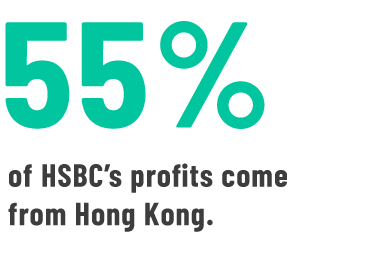
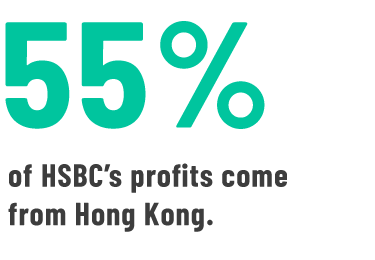
Even if the bank has been established in the United Kingdom since 1992, Hong Kong is its largest market and represents more than half of the group's profits. Asia generated more than 80% of HSBC's profits more broadly last year. The bank plans to transfer more resources to the region in the near future as it implements a major restructuring plan.
HSBC declined to comment on support for the law. But company executives have reason to worry about the potential fallout.
HSBC President Mark Tucker privately warned the British government that the bank could face retaliation from Beijing if Chinese tech giant Huawei is prevented from doing business in the UK, the Telegraph last month, citing anonymous sources.
Divided between two worlds
HSBC was founded in 1865 by Scottish businessman Thomas Sutherland, who drew inspiration from the flag of his home country to create the bank's iconic red and white hexagonal logo.
Until the 1990s, it was generally referred to simply as "the bank of Hong Kong", according to historians David Kynaston and Richard Roberts, who followed the rise of the company in the book "The Lion Wakes: A Modern History of HSBC ".
He even once acted as Hong Kong's unofficial monetary authority in some respects as the city's economy opened up to the world, printing currency and paving the way for currency,Kynaston and Roberts wrote.
"You could say we are a near-central bank," said former HSBC president Michael Sandberg in the book in 1976. "Hong Kong's interests and well-being are very much in line with ours. ".
In 1992, HSBC moved its headquarters to London to comply with buyout rules after the acquisition of Midland Bank, a large British retail bank that helped its new owner almost double its workforce.
Since then, the company has periodically considered the idea of relocating its headquarters away from London.
In 2015, the same year, the bank announced a "pivot to Asia", the board of directors deliberated on this decision, carrying out a review of its operations around the world over 10 months. Hong Kong was considered the natural choice, given its deep roots and the lure of lower corporate taxes. But the leaders of the company finally decided not to move.
Former CEO Stuart Gulliver said at the time that having a head office in the UK and a "significant" part of the business in Asia Pacific "offers the best of both worlds to our stakeholders ".
Even if the company's business grows elsewhere, HSBC may want to stay in London so as not to lose its status as a global bank, according to Dragon Tang, professor of finance at the University of Hong Kong. He added that moving away from the UK could be seen as a sign of abandonment in the European market.
A company spokesperson referred CNN Business to a previous statement that said "there are no discussions to review the global headquarters of HSBC and no plans to reopen the problem".
Forced to choose
HSBC has a lot to do with Hong Kong - and politicians know this.
In May, former Hong Kong chief Leung Chun-ying denounced the bank for its silence on the law, demanding that HSBC express its support.
"HSBC's profits come mainly from China", writes Leung in a Facebook Publish. "Neither China nor Hong Kong owes anything to HSBC. Its activity in China could be replaced overnight by Chinese or foreign banks."
Leung also told the Financial Times this month that "HSBC enjoys privileges unique to Hong Kong, which should not be taken for granted."
A few days later, HSBC posted a photo on Chinese social media showing its Asia-Pacific CEO signing a petition supporting the national security law in Hong Kong. (The photo was published before the law was passed and before the full legal text was published.)
Britain did not take long to respond. British political leaders piled on the bank last month, wondering why the company would allow one of its leaders to make such a political statement.
"I just thought, 'Wow,'" said Alistair Carmichael, a British lawmaker who joined several MPs in writing to HSBC to express concern about the decision. He argued that by giving in to Beijing's demands, the company has essentially "presented itself" as political football.
"They didn't do anything good," Carmichael told CNN Business, adding that he and his colleagues still hadn't heard from the bank. "Once you choose a camp, it is very difficult to get away from that camp."
HSBC declined to comment on the criticism the bank has received from British politicians.
The bank has also long been touted as a potential target of retaliation by Beijing for its battle with the West over trade, technology and national security.
Huawei, for example, has been trying for months to convince the British government that it can be trusted to help build the country's 5G network - a partnership that seems to be falling apart more and more.
Liu, the Chinese ambassador, warned this week that Britain "will have to bear the consequences" if it treats China as a "hostile country".
And although he did not mention HSBC by name, Chinese state media previously suggested that the bank may be on a rumored list of "unreliable" foreign companies that China may blacklist.
China's retaliation is not all that HSBC needs to worry about. US Secretary of State Mike Pompeo lambasted the company for its actions, saying that "corporate aches" should not be respected by the bank in Beijing.
Bloomberg reported on Tuesday that Washington was also looking for "ways to punish Hong Kong-based banks, especially HSBC." According to the report, one proposal is to damage the parity between the Hong Kong dollar and the United States dollar.
HSBC declined to comment on the report. Shares of the company listed in Hong Kong fell 4.3% on Wednesday after the report, while its shares listed in London fell 2.9%. The title continued to collapse on Thursday in Hong Kong.
There is also discomfort among HSBC staff. An HSBC employee who has worked for the bank for several years told CNN Business that Hong Kong workers were upset when they learned that the company supported the law.
"I am so disappointed," said the employee, who requested anonymity because he feared being targeted for his remarks. "Obviously, the bank could imagine that there are concerns."
HSBC declined to comment on staff reaction.
Employee said he wrote to management last year to express concern over Hong Kong's increasingly politicized business environment and was assured by the company that it would stay away of the political fray.
"I was very proud of the bank," he said. But "if you asked me whether I feel proud or not to be one of the members of this bank, the answer would be" no "for the moment."
As a diplomattensions are simmering, some observers warn that the company could once again be forced to leave the political fence.
"They are between the devil and the deep blue sea. They will want to see how the situation in China and Hong Kong stabilizes. They will want to see how the political heat in the United Kingdom persists", Philip Augar, a British banking expert, told BBC Radio 4 on Tuesday.
"But in the end," he added, "I think they have to listen to the Chinese side more."
- Sharon Braithwaite and Charles Riley of CNN contributed to this report.





