


The PS2 BIOS is like the conductor of a video game orchestra. It’s the important software that made the PlayStation 2 console so special. Understanding how it works gives us a peek into the amazing technology that powered this legendary gaming system.
The PS2 BIOS is not just a technical marvel, it’s also a nostalgic reminder of a time that still influences today’s games. People have even used it to bring old games back to life on new devices. And fans have even tinkered with it to create new ways to play.
The PS2 BIOS is a big part of gaming history and continues to shape the future of video games.
Download PS2 BIOS Latest Version 2024
Download the updated PS2 BIOS (2024 version) for enhanced performance and compatibility. Get the latest features for your PlayStation 2 emulation now!
File Name: ps2_bios.zip
File Size: 12.76 MB
Rating:
Downloads: 2857118
dOWNLOAD nOW
Overview
The BIOS, also known as Basic Input/Output System, is like the conductor of an orchestra for the PlayStation 2 console.
It controls all the hardware and makes sure everything works together when you turn on the console. Without the BIOS, the PS2 wouldn’t be able to do much – it wouldn’t be able to play games, save data, or even work properly.
The PS2 BIOS does more than just start up the console. It helps the system manage things like the memory card, DVD drive, and controllers while you’re playing games.
It’s like the PS2’s secret ingredient that makes everything run smoothly.
The PlayStation 2 was released in March 2000 and was a huge leap forward in gaming. The BIOS played a big part in making the PS2 such a success.
Without it, the PS2 wouldn’t have been able to do all the amazing things it did. The BIOS is the unsung hero that made every gaming session, victory, and moment of wonder possible.
Architecture of PS2 BIOS
You’ll find the PS2 BIOS isn’t just a bridge between hardware and software, but a sophisticated architecture tailored for an immersive gaming experience.
It seamlessly orchestrates the interaction of the console’s CPU, memory, and peripherals, setting it apart from its predecessors and successors like the PS1 and PS3.
To appreciate its uniqueness, let’s analyze how the PS2 BIOS’s technical specifications compare to other gaming systems’ BIOSes.
How the BIOS interacts with the PS2 hardware, Comparison with BIOS of other gaming consoles (like the PS1 or PS3)
The PS2’s BIOS is like a middleman between the hardware and the games you play. It helps start up the console and makes sure all the parts like the CPU and GPU can talk to each other. It also helps the games and operating system run smoothly.
The PS1’s BIOS was simpler because its hardware was simpler, while the PS3’s BIOS had to handle more complicated tasks because of its advanced technology. Each console’s BIOS matches the complexity of its hardware, changing to keep up with what gamers and game makers need.
Functionality of PS2 BIOS

As you power on your PS2, the BIOS springs into action, orchestrating the boot process that breathes life into the console’s operations.
It’s the BIOS that manages system configurations and settings, ensuring your gaming experience is consistent with your preferences.
Beyond initial booting, the BIOS plays a pivotal role in game loading, execution, and the seamless integration of peripherals and external devices.
The boot process: How the PS2 BIOS initiates the console’s operations
When you turn on the PlayStation 2, the BIOS starts an important boot process to get the console ready for gaming.
First, it does a check to make sure everything is working properly. If there’s a problem, you’ll hear beeps or see lights flashing.
Then, the BIOS sets up the CPU, memory, and other important parts, and makes sure they can talk to each other. It also checks that the system software is good to go, and loads the drivers needed for things like controllers and screens.
System configuration and settings management
The PS2 BIOS does more than just start the system; it also lets you change and manage the console’s settings to customize your gaming experience.
In this menu, you can adjust the system language, date and time, and screen aspect ratios.
You can also manage your memory cards, format them for use, or transfer data between slots.
The BIOS also lets you adjust audio settings to match your home entertainment system, and set parental controls to limit game usage based on content ratings.
It’s easy to navigate through these settings to optimize your console.
Role in game loading and execution
When you turn on your PS2, the BIOS gets everything ready for your games to start. It makes sure all the parts of the console are working, like the memory cards and controllers.
Then, when you put in a game disc, the BIOS helps the game start running. It sets things up behind the scenes so you can jump into your favorite adventures on the screen.
Support for peripherals and external devices
The PS2 BIOS plays a crucial role in enhancing your gaming experience by smoothly connecting a variety of peripherals and external devices, like dual shock controllers and USB accessories.
It acts as the middleman, making sure that all the devices you connect work properly by facilitating communication between the hardware and the software.
The BIOS not only recognizes the devices but also manages the flow of data between them and the central system. This includes handling controller inputs, setting up network adapters for online gaming, and supporting memory cards for game saves.
The BIOS effectively handles these interactions, ensuring that your gaming sessions run smoothly and showcasing the console’s versatility in connectivity.
Updates and Versions of PS2 BIOS
As you explore the evolution of the PS2 BIOS, you’ll notice the system’s heartbeat strengthened with each update. Each version brought its own set of enhancements and fixes, directly influencing game compatibility and the functionality of peripherals.
Understanding these versions is key to grasping how the PS2 maintained its dominance in the console market for years.
Different versions of PS2 BIOS released over time
During the life of the PlayStation 2, Sony released different versions of the PS2 BIOS to improve the console’s performance and user experience. These updates varied from small adjustments to significant changes, making it easier to use the console and play games.
Here’s a summary of key versions:
SCPH-10000 2000 First release
SCPH-30001 2001 Improved stability
SCPH-50001 2002 Faster loading times
SCPH-70012 2004 Added IR support
Each update aimed to provide a smoother and more reliable gaming experience, demonstrating Sony’s dedication to keeping the PS2 at the forefront of the gaming industry.
The evolution of the BIOS played a crucial role in maintaining the PS2’s reputation as a legendary gaming console.
Notable changes and updates in each version
Building on the foundation of previous BIOS versions, let’s explore the specific improvements that each update brought to the PlayStation 2, making it a stronger competitor in the gaming market. These updates ensured that your gaming experience continued to get better over time.
Here’s a closer look at what each version improved:
Initial Versions
- Stability: Made the system more stable for smoother gameplay.
- Compatibility: Enhanced game compatibility, reducing the chances of encountering errors.
Mid-cycle Updates
- Speed: Made boot and loading times faster.
- Networking: Improved network functionalities for online gaming.
Later Revisions
- Security: Strengthened security measures to prevent piracy.
- Functionality: Refined the user interface for easier navigation.
Each update contributed to a more seamless and enjoyable gaming experience, demonstrating Sony’s dedication to user satisfaction.
Impact of BIOS versions on compatibility with games and accessories
Every time Sony released a new version of the PS2 BIOS, it had a big impact on which games and accessories would work with the console.
The BIOS updates were meant to make the system more stable, improve how games ran, and add support for new accessories.
It’s kind of like updating the software on your computer – each new version could make certain games or controllers work better than before.
But here’s the thing: sometimes a new BIOS update would make it so that older games or accessories didn’t work as well as they used to.
So, deciding whether or not to update your system wasn’t always an easy choice.
You’d to think about whether the benefits of the update were worth the risk of messing up the games and accessories you already had.
PS2 BIOS in Emulation
You’re entering the intricate realm of PS2 BIOS within emulation, where its role is pivotal to recreating the authentic gaming experience on modern hardware.
You must navigate the murky waters of legality and ethics, as using PS2 BIOS files in emulators often treads a fine line between preservation and piracy.
Moreover, you’ll encounter technical hurdles, as accurately emulating PS2 BIOS and games poses significant challenges to developers and enthusiasts alike.
The role of PS2 BIOS in emulation software
Emulation software uses the PS2 BIOS to mimic the original console’s operations on modern hardware, giving new life to classic games.
The BIOS plays a crucial role in emulators by handling system initialization, execution management, and input/output supervision.
It ensures that games run smoothly and accurately, making the experience feel like playing on a real PS2 console. Understanding the BIOS’s functions is important for appreciating its significance in emulation.
Legal and ethical considerations in using PS2 BIOS for emulation
Emulators need the PS2 BIOS to work well, but it’s important to think about the rules and what’s right when using this software.
Getting or sharing PS2 BIOS files without owning the original hardware might break copyright laws. This means you’re using Sony’s stuff without permission.
Copyright laws are different in different places, but they generally protect original works, like the PS2 BIOS.
Using PS2 BIOS files without permission mightn’t be fair to the people who made the system.
It’s good to remember that while emulation itself is okay, getting BIOS files from the internet usually isn’t, unless the source has the right to share them.
Always try to respect other people’s stuff and think about the rules before you get and use PS2 BIOS files.
Challenges in emulating PS2 BIOS and games
Emulating the PS2 BIOS and its games is a tough task due to the system’s unique architecture and advanced security measures.
The PS2 has a custom Emotion Engine CPU, proprietary Graphics Synthesizer GPU, and different types of RAM, making it complex to replicate.
Additionally, the BIOS has multiple layers of functions, games have specific optimizations, and real-time system calls to handle. Moreover, there are security measures like region lock encoding, BIOS checksum validations, and copy protection schemes to overcome.
This emulation challenge requires a deep understanding of the PS2’s operations while ensuring that games remain intact and legal boundaries are respected.
Modifications and Customizations
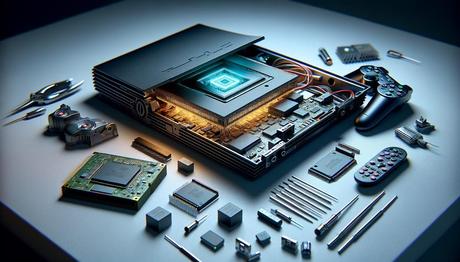
You’ve entered the realm of PS2 BIOS modifications, where custom firmware and unofficial tweaks can unlock new potential in your gaming console.
Weighing the risks and benefits of these modifications is crucial; while they offer enhanced functionality, they can also void warranties and lead to stability issues.
The contributions from the community have been pivotal, continuously pushing the boundaries of what’s possible with PS2 BIOS customization.
Custom firmware and unofficial modifications
When people customize the PlayStation 2 with custom firmware and unofficial modifications, they can do a lot more than what the console was originally designed for. You might find it interesting to see the different ways you can customize it, like:
- Making it Better: Adding new features and functions.
- *Playing Media*: Watching different types of files.
- *Special Apps*: Using software that’s not officially approved by Sony.
- *Changing Games*: Adding new stuff made by fans.
But, making these changes can have some risks, like losing the warranty or things not working right. Still, lots of people think it’s worth it to make their gaming experience just right for them.
When you get into this, it’s not just about playing games anymore; it’s about making your PS2 fit your gaming style.
Risks and benefits of modifying the PS2 BIOS
Customizing your PS2 can make your gaming experience better, but it’s important to think about the good and bad parts of changing the console’s BIOS.
On the good side, a modified BIOS might let you do new things, like playing games from different places or using homebrew apps. These changes can make your console more fun and unique.
But changing the BIOS has risks. You could accidentally break your console and make it stop working. It might also break the rules and cancel your warranty. Plus, it could make your system easier for bad software to attack.
Always think about these things before you make any changes.
Community contributions and developments in PS2 BIOS customization
In the world of PS2 BIOS customization, passionate fans have made significant contributions, creating a variety of changes that improve the console’s functions and make the gaming experience more personal. These modifications aren’t just about looks; they also expand what the hardware can do.
Custom Firmware:
- Better Compatibility: Play games from different regions.
- Improved Performance: Increase speed for better gameplay.
- Additional Features: Add homebrew applications.
Graphical User Interface (GUI) Mods:
- New Themes: Customize the appearance to your liking.
- Easier Navigation: Simplify menus for easier use.
- Personal Touches: Add custom startup sounds and logos.
Community Tools:
- BIOS Dumper Software: Safely extract your console’s BIOS.
- Patching Utilities: Apply mods without deep technical knowledge.
- Tutorial Platforms: Forums and guides that explain the process.
With these customizations, your PS2 becomes more than just a gaming console; it becomes a reflection of the creativity of its community.
Legacy and Impact

You can’t discuss the PlayStation 2’s enduring legacy without acknowledging the central role played by its BIOS, which laid the groundwork for a gaming revolution.
Its influence extends beyond mere nostalgia, shaping console development and gaming culture to this day.
In comparing it to contemporary console BIOS, you’ll find that the PS2’s architecture set benchmarks that continue to inform design decisions.
The role of PS2 BIOS in the legacy of PlayStation 2
The PS2 BIOS was crucial in making the PlayStation 2 a huge success in the gaming world. While you may love the console’s games and cool design, the BIOS worked behind the scenes to make it all possible. It got the system ready for gaming when you turned it on and made sure everything ran smoothly.
Starting Up:
- Getting Ready: The BIOS got all the console’s parts ready when you turned it on, so you could start playing right away.
- Connecting Everything: It made sure the software and hardware could work together.
Making Games Work:
- Playing Old Games: It let the PS2 play games from the original PlayStation, making the game collection even bigger.
- Running Games: The BIOS made sure games worked properly by managing the system and memory.
Making It Easy for You:
- Home Screen: It powered the easy-to-use menu where you could manage game saves, settings, and more.
- Playing Movies and Music: The BIOS also let you watch DVDs and do other things besides gaming on the PS2.
The PS2 wouldn’t be the same without the BIOS making everything run smoothly.
Its impact on gaming culture and console development
The PS2 BIOS had a big impact on gaming culture and how consoles were made. It helped video games become more popular for everyone, not just kids.
The PS2 could play DVDs, which made it popular with families. It also started the idea of consoles being able to do more than just play games.
The PS2 was also one of the first consoles to let you play older games on it, which made people like the brand more and kept old games alive.
The way the PS2 BIOS was made also influenced how future consoles were designed, focusing on being able to do lots of different things and being easy for people to use.
Comparison with modern gaming console BIOS
The modern gaming console BIOS has come a long way from the PS2 BIOS. It now supports enhanced multimedia capabilities like streaming services integration, social media connectivity, and a high-resolution user interface.
It also facilitates greater user interaction through features like user profiles, parental controls, voice command recognition, and seamless online multiplayer experiences.
Additionally, it offers improved system performance with faster boot times, enhanced security features, and regular firmware updates.
This evolution represents a shift in how you use your gaming console, turning it into a comprehensive entertainment hub rather than just a gaming platform.
wrapping Up
The PS2 BIOS was like the heart of a gaming revolution. It wasn’t just a starting button for games; it also made old games work on new systems. Sony kept making it better, and people who change things in games made it even cooler.
The PS2 BIOS is super important because it started a big change in gaming that we still see today.




THE %(site_name)s COMMUNITY

-
 umkhaloodie
3864140 pt -
Ch
3396455 pt -
 jesusmsanchezl
2453003 pt -
weddingblog2011
2205852 pt